
Updated for the TOEFL iBT format introduced in January 2026
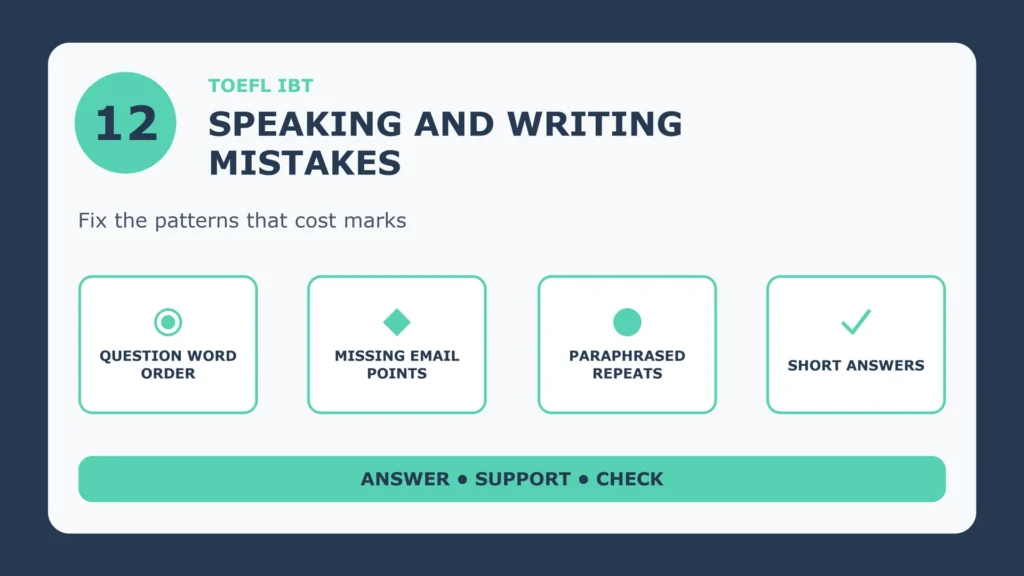
The TOEFL iBT Speaking and Writing sections were redesigned in January 2026. ETS lists Writing at 12 items in about 23 minutes and Speaking at 11 items in about 8 minutes. The older integrated essay, independent essay and four-task Speaking section are no longer part of the test description, so templates built for them can now work against you. These are the mistakes that matter most in the current tasks.
Writing
Build a Sentence
You arrange words or phrases to form a complete, grammatical sentence or question.
- Mistake: statement word order in a question (“Where the library is?”).
- Fix: check for an auxiliary or question word first: Where is the library?, When did the class start?
- Mistake: misplacing prepositions, adverbs or relative clauses.
- Fix: read your finished sentence aloud in your head. If it sounds unnatural, check the verb and its object first.
Write an Email
You write an email in an academic or social situation, such as making a request, giving information or proposing a solution.
- Mistake: missing one of the points the task asks you to cover.
- Fix: before writing, list every required point and tick each one off as you include it.
- Mistake: the wrong tone, such as too casual for a professor or too formal for a classmate.
- Fix: match the greeting, requests and closing to the reader.
- Mistake: no clear purpose in the first lines.
- Fix: state why you are writing in your first or second sentence.
Write for an Academic Discussion
You contribute to an online classroom discussion by stating and supporting your opinion.
- Mistake: repeating what other participants have already said.
- Fix: refer to another view briefly, then add your own reason or example.
- Mistake: a clear opinion with no support.
- Fix: give at least one specific reason and one example.
ETS says Writing scoring focuses on how clearly and effectively you communicate your ideas, not on writing a perfect first draft. Clear organisation and relevant support matter more than rare vocabulary.
Speaking
Listen and Repeat
You listen to short sentences and repeat them exactly.
- Mistake: paraphrasing or summarising instead of repeating.
- Fix: repeat the sentence word for word, keeping small words such as articles and prepositions.
- Mistake: rushing and blurring word endings.
- Fix: copy the speaker’s rhythm and stress rather than trying to speak faster.
Take an Interview
You answer questions in a simulated interview about academic or campus situations, drawing on your experiences and opinions.
- Mistake: one-sentence answers.
- Fix: answer, give a reason, add a short example.
- Mistake: reciting a memorised template.
- Fix: practise flexible patterns (“One reason is…”, “For example, last term…”) and use them only when they fit the question.
- Mistake: speaking too fast.
- Fix: aim for a natural pace with short pauses between ideas.
Habits that help in both sections
- Review old materials critically. If a guide mentions integrated essays or four speaking tasks, it describes the previous format.
- Record and reread. Keep dated recordings and emails so you can see progress.
- Fix one pattern a week, such as question word order or dropped word endings, instead of trying to fix everything at once.

Quick FAQ
Is there still an integrated writing task? ETS’s current Writing section description lists Build a Sentence, Write an Email and Write for an Academic Discussion only.
How are scores reported? Each section is scored on a 1–6 scale, and the overall score is the average of the four sections rounded to the nearest half band. During a two-year transition after January 2026, reports also show a comparable 0–120 overall score.
Official ETS sources
- TOEFL iBT test content
- TOEFL iBT Writing section
- TOEFL iBT Speaking section
- Understanding TOEFL iBT scores
Accuracy note (14 September 2026): this article reflects the TOEFL iBT format introduced in January 2026. Check ets.org for the latest details before your test.
Ready for structured practice? See the TOEFL iBT course.