
Updated for the TOEFL iBT format introduced in January 2026
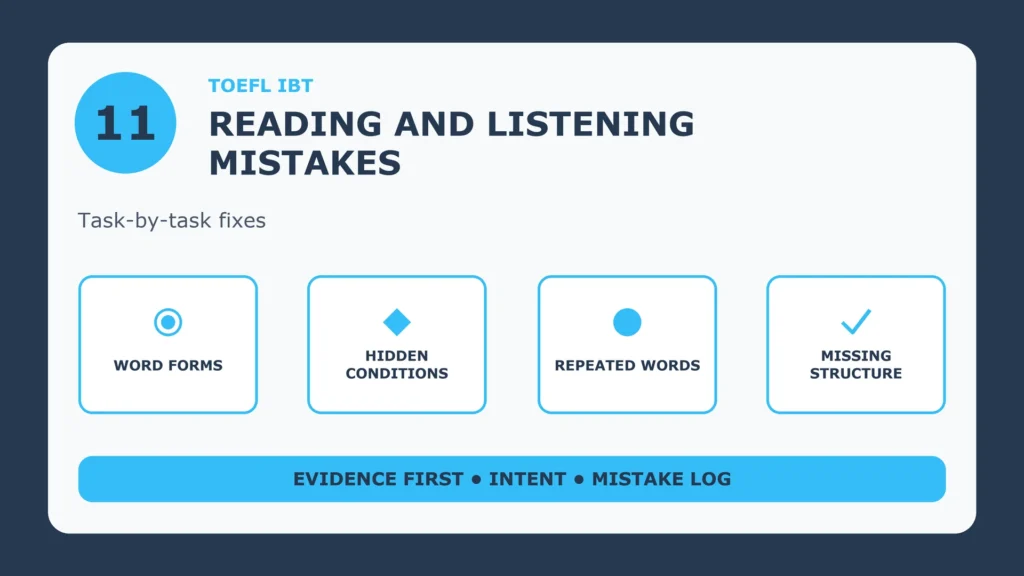
The TOEFL iBT Reading and Listening sections now use shorter, more varied tasks, and both sections are adaptive: as the test adjusts to your level, the number of items and the timing can vary. ETS lists Reading at 50 items in about 30 minutes and Listening at 47 items in about 29 minutes. Advice written for the older format, with long passages and long lectures only, misses several of the current task types. Here are the mistakes that cost the most marks now, and how to fix them.
Reading
Complete the Words
You complete partially missing words in a short text. ETS says this measures vocabulary knowledge and the ability to understand meaning from context.
- Mistake: guessing a word from its first letters without checking the sentence.
- Fix: read the whole sentence first. Decide what the gap needs (a noun, a verb, a past tense, a plural) before you complete it, and check spelling carefully.
Read in Daily Life
You read short everyday texts such as notices, messages or short informational texts. Questions test main ideas, key details and implied meaning.
- Mistake: skimming past dates, times, conditions and exceptions (“except on Fridays”, “only if…”).
- Fix: before answering, note who the text is for, what it asks the reader to do, and any condition attached.
- Mistake: missing implied meaning, such as what a writer expects to happen next.
- Fix: ask “Why was this message written?” as well as “What does it say?”
Read an Academic Passage
You read a short academic passage similar to university course material. Questions test main ideas, supporting details and important vocabulary.
- Mistake: answering from background knowledge. ETS notes that all the information you need is in the text.
- Fix: point to the sentence that supports your answer before you choose it.
- Mistake: confusing a supporting example with the main idea.
- Fix: summarise each paragraph in a few words as you read.
Listening
Listen and Choose a Response
You hear a short spoken prompt and choose the most appropriate response. ETS says this measures understanding of meaning, intent and common patterns of spoken English.
- Mistake: choosing an option because it repeats words from the prompt.
- Fix: listen for the speaker’s intent (a request, a complaint, an offer, a question) and pick the response that fits that purpose.
Listen to a Conversation
Conversations are mainly about campus life. Questions test main ideas, key details, speaker intent and implied meaning.
- Mistake: following the details but missing the speaker’s problem or decision.
- Fix: note three things: the problem, the options discussed, and what the speaker decides or feels.
Listen to an Announcement
Announcements are set in academic or campus situations. Questions test the speaker’s purpose, key information, implied meaning and likely next actions.
- Mistake: ignoring what listeners are expected to do next.
- Fix: listen for deadlines, changes and instructions; these often carry the “next action” answer.
Listen to an Academic Talk
A professor or expert gives a short academic talk. Questions test main ideas, supporting details, organisation, inferences and sometimes uncommon or idiomatic vocabulary.
- Mistake: writing everything down and losing the structure.
- Fix: note the topic, the main point, and signal words that show organisation (first, however, as a result).
Across both sections
- Don’t panic about difficulty. The test is adaptive, so a harder set of questions can simply mean the test is adjusting to your level.
- Keep a mistake log by task type, and review it before each practice session.
- Practise with current materials. Check that any practice test uses the task names above.

Quick FAQ
Are Reading passages still long? The current section uses short texts, everyday texts and a short academic passage rather than only long passages.
Is note-taking still useful? Yes, especially for conversations and academic talks, but keep notes brief and focused on structure.
Official ETS sources
Accuracy note (14 September 2026): this article reflects the TOEFL iBT format introduced in January 2026. Check ets.org for the latest details before your test.