
One test, many situations
TOEFL Essentials moves between everyday situations and academic ones throughout the test. One minute you may be reading a menu or listening to a conversation about housing; the next you are working with an academic table or a talk about history. Being comfortable in both registers, and switching quickly, is a skill you can practise.
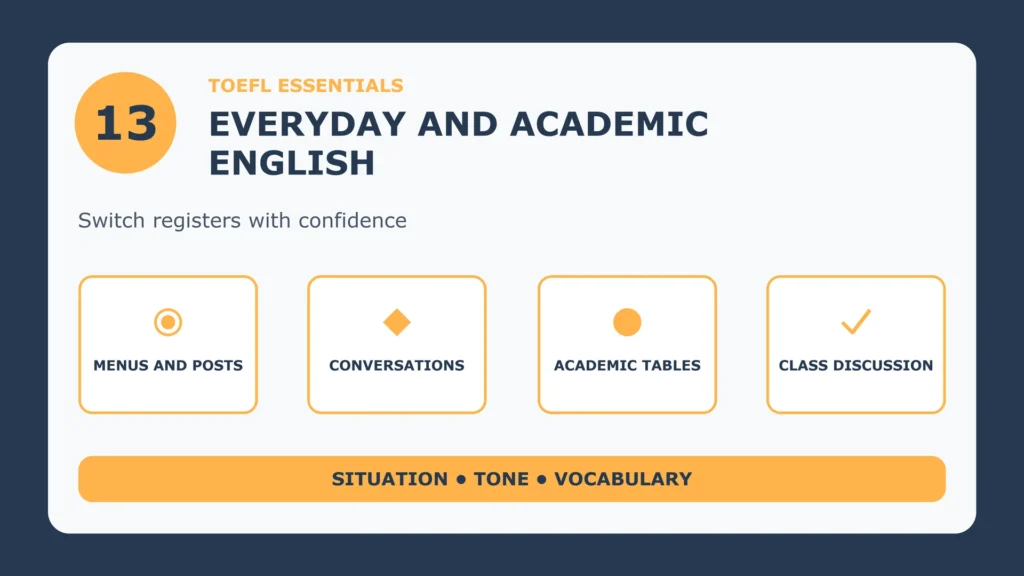
Where the switches happen
| Section | Everyday contexts | Academic contexts |
|---|---|---|
| Listening | Short exchanges; conversations about dining, entertainment, health, housing or travel | Academic announcements; talks of 100–250 words on subjects like history, art, business or science |
| Reading | Daily Life texts such as a poster, menu, social media post or news article | Academic tables (50–85 words) and passages (about 200 words) on science, history, art and business |
| Writing | An email for a purpose such as an invitation; or a social media post describing a photo | Or a post in an online class discussion |
| Speaking | Reading aloud one part of a daily life dialogue | Listen and Repeat sentences in academic or social scenarios; a Virtual Interview about your experiences and opinions |
Skills that help you switch
- Recognising the situation fast. Ask: who is speaking or writing, to whom, and why?
- Adjusting tone. Friendly and natural for a social media post; clear and reasoned for a class discussion.
- Vocabulary in both registers. Get in touch and contact; a lot of and a substantial number of.
- Following different accents. ETS says Listening includes accents from North America, the UK, Australia and New Zealand.
Strategies
- Pair your practice. Each session, do one everyday task and one academic task back to back.
- Rewrite in two registers. Take a short paragraph and rewrite it as a text to a friend and as a formal note.
- Read widely and briefly. Mix notices, menus and posts with short science or history texts.
- Listen to a range of voices, from casual podcasts to short lectures, including different English accents.
- Practise both writing options. Your test includes either Describe a Photo or Write for an Academic Discussion, so prepare for both.
Common mistakes
- Writing a photo post in stiff, formal language, or a discussion post that sounds like a chat message.
- Missing practical details, such as times, prices or conditions, in everyday texts.
- Treating academic texts as general knowledge instead of reading what the text actually says.
Official ETS sources
- TOEFL Essentials Listening section
- TOEFL Essentials Reading section
- TOEFL Essentials Writing section
- TOEFL Essentials Speaking section
Accuracy note (15 September 2026): check ets.org for current test content.