Two unscored questions that let institutions hear from you
After the scored sections of TOEFL Essentials, you record a Personal Video Statement. ETS describes it as a way to share additional insights about yourself and show your personality to institutions. Your responses are not scored, but the institutions you send scores to can see them, so it is worth preparing.
How it works
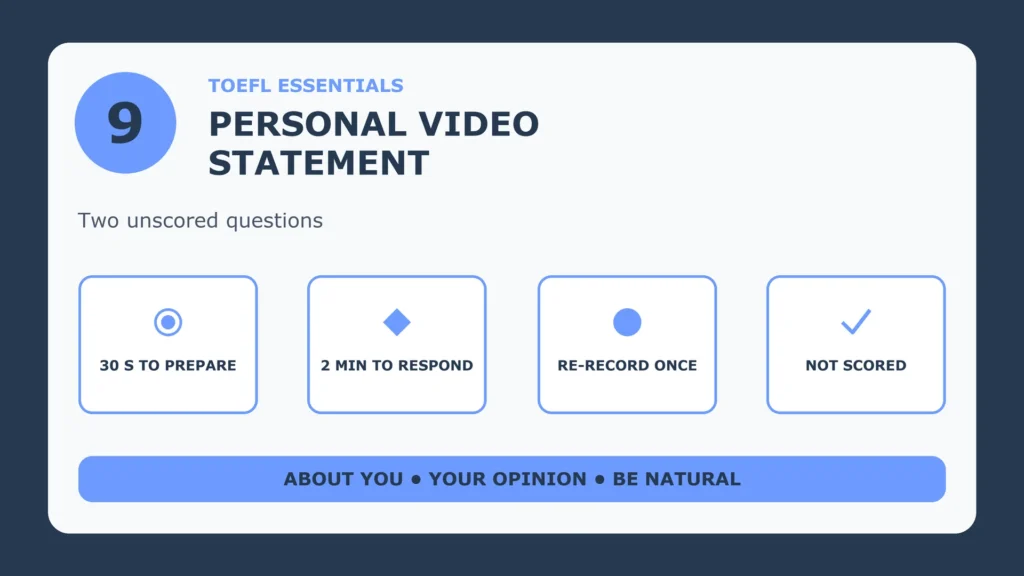
- When: after you complete the scored portions of the test.
- Length: about 5 minutes, not including re-recording.
- Questions: two.
- The first question is always: “What would you like to tell people about yourself?”
- For the second, you choose one of two randomly selected topics and give your opinion.
- Timing: for each question, you have 30 seconds to prepare and 2 minutes to respond.
- Re-recording: if you’re not happy with a response, you can record it again, and only the second recording is saved.
- Scoring: not scored.
Where it goes
Institutions that receive your TOEFL Essentials scores through ETS’s TOEFL Showcase can see your Personal Video Statement alongside your scores and other information about your performance.
Question 1: telling people about yourself
You have two minutes, so plan a simple shape:
- Who you are: name, what you study or do, where you are from if you wish.
- What drives you: a goal, such as your study plans, and why it matters to you.
- One detail that makes you memorable: an interest, experience or achievement.
- A closing line that links back to your goal.
Avoid reciting a memorised script; it tends to sound flat. Prepare the points, not the sentences.
Question 2: giving your opinion
Because you choose between two topics, pick the one you can talk about more concretely.
- State your opinion clearly in the first sentence.
- Give two reasons, each with a short example.
- Finish by restating your view in different words.
How to prepare
- Practise on camera at home. Watch the recording and check your pace, clarity and eye contact.
- Time yourself: 30 seconds to jot key words, then speak for up to two minutes.
- Practise both question types with a range of opinion topics, such as study, technology, work and daily life.
- Plan your re-record rule in advance: re-record only if something clearly went wrong, since only the second recording is kept.
On the day
- Look at the camera, speak at a natural pace and keep your face clearly visible.
- If you lose your place, pause briefly and continue; natural recovery is part of real communication.
Quick FAQ
Does the Personal Video Statement affect my score? No. It is not scored.
Can I skip preparing for it? You can, but institutions may watch it, so a clear, genuine response is worth a little practice.
Official ETS sources
Accuracy note (15 September 2026): details reflect ETS’s current description. Check ets.org before your test.