
Work back from your earliest deadline
A common application problem isn’t the score itself but timing: results that arrive after a deadline, or a test taken so early that it is too old by the time a course starts. Plan your English test as part of your application calendar.
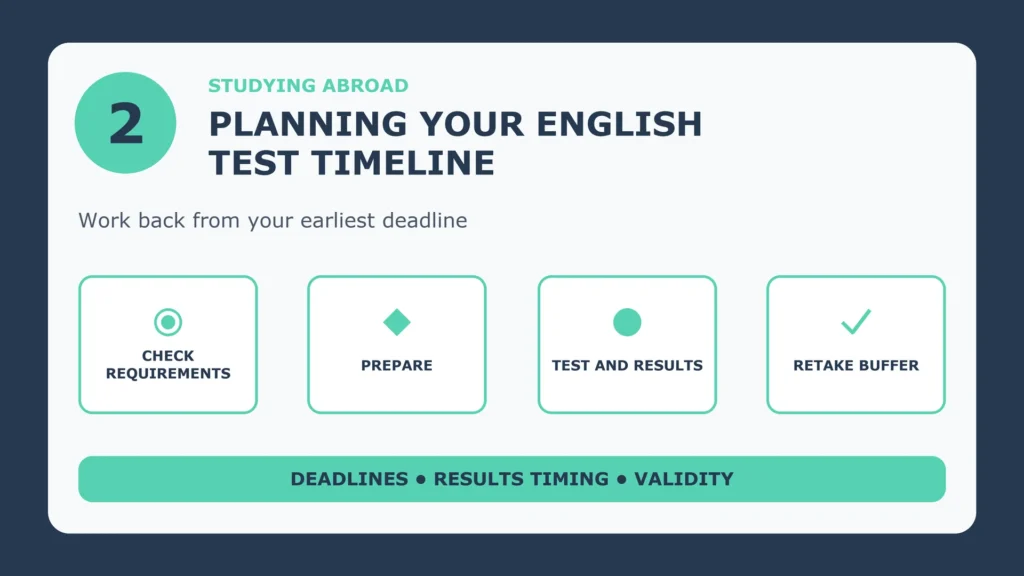
Step 1: list your deadlines
For each university and programme, note:
- the application deadline;
- the deadline for submitting English test results, which may be later than the application deadline for conditional offers;
- how recent your test must be when you apply or when the course starts.
Your earliest relevant date drives the plan.
Step 2: allow preparation time
Take a diagnostic practice test first. A small gap between your result and your target may need a few weeks of focused practice; a large gap may need several months. Our study plans are a useful starting point:
Step 3: know how long results take
| Test | Results available (as stated by the test provider) |
|---|---|
| IELTS on computer | 1–5 days (IELTS reports most within two days) |
| IELTS Online | 6–8 days |
| IELTS on paper | Up to 13 days |
| TOEFL iBT | Official scores in your ETS account 3 days after the test |
| TOEFL Essentials | Official scores in your ETS account 5–6 days after the test |
For other tests, check the provider’s current results timeline.
Step 4: check validity
- TOEFL iBT and TOEFL Essentials scores are valid for 2 years from the test date.
- IELTS recommends that results show English ability for up to two years, and organisations can choose to accept older results.
Don’t test so early that your result expires before a university needs it.
Step 5: build in a retake buffer
If your first result falls short, you need time to prepare and test again before the deadline. A practical plan leaves room for a second attempt. With IELTS on computer, One Skill Retake lets you retake one skill within 60 days of your full test, if your target universities accept it.
A sample backwards plan
| Weeks before the results deadline | Action |
|---|---|
| 16+ | Check requirements; take a diagnostic |
| 12–16 | Start structured preparation |
| 8–10 | Book the test for a date that leaves a retake buffer |
| 6–8 | Take the test |
| 2–6 | Results arrive; retake if needed |
| 0–2 | Send results to universities |
Adjust this to your own gap and deadlines.
Common mistakes
- Booking the test for the week of the deadline.
- Forgetting that some universities need results before issuing offers.
- Taking the test so early that the result expires.

Related reading
- How to Create a 12-Week English Test Prep Plan Before Studying Abroad
- Common English Test Mistakes That Can Delay Your College Application
Accuracy note (15 September 2026): results timelines and validity rules can change. Confirm with the test provider and each university.