
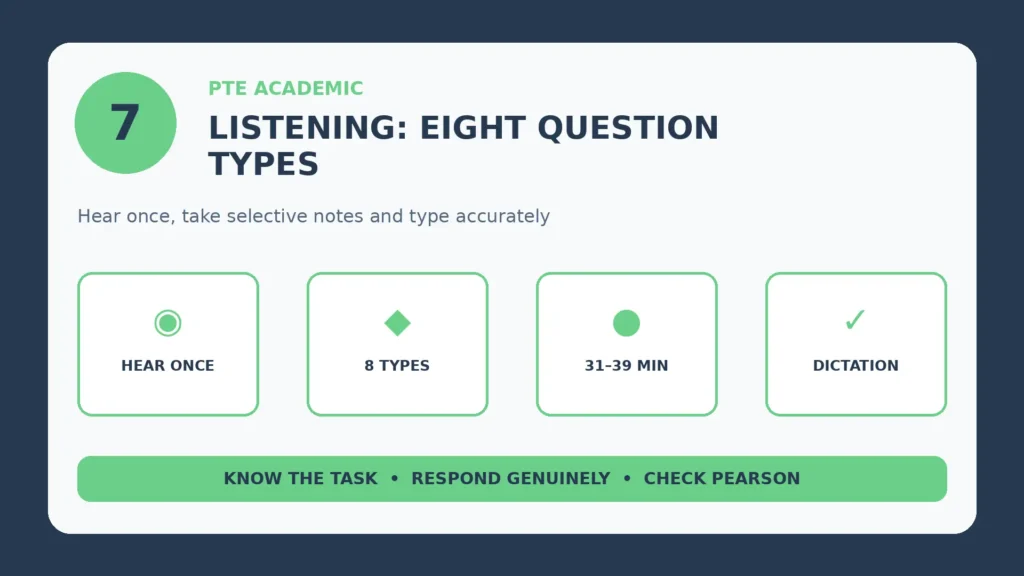
Hear once, take selective notes and type accurately
The Listening part lasts approximately 31–39 minutes and contains eight question types. Audio or video begins automatically, is heard once and may be accompanied by note-taking. Tasks range from extended summarising to exact dictation, so one listening strategy cannot serve every item equally well.
Summarize Spoken Text requires a concise written account of the main idea and important support. Notes should capture hierarchy and relationships, not every phrase. Highlight Correct Summary and multiple-choice tasks demand recognition of purpose, development and detail. Beware options that repeat vocabulary while changing the speaker’s meaning.
Read More: Reading: Five Question Types
Listening: Fill in the Blanks and Highlight Incorrect Words combine audio tracking with accurate reading. Keep your eyes close to the current phrase without racing ahead. Select Missing Word often depends on the logic and tone built across the passage, not only the final sound.
Write from Dictation is short but demanding. Listen for meaning groups, hold the sentence structure, type accurately and check grammar, spelling and plural endings. Practise chunking and immediate reconstruction instead of trying to preserve a fragile stream of individual sounds.
Multiple Choice Multiple Answers may apply negative marking for wrong choices, so avoid indiscriminate selection. Use notes to confirm claims and select only defensible options. Since audio plays once, recover quickly after a missed phrase rather than sacrificing the remainder.
Develop listening through targeted replay during review, even though the real test gives one hearing. First answer under official conditions. Then locate the breakdown using transcript and audio, classify it—sound recognition, vocabulary, attention, paraphrase, note overload or typing—and listen again without the transcript. Regular exposure to varied academic voices helps, but precise correction turns exposure into measurable performance.
A practical preparation method
Start with the current official format and a diagnostic test. Record the score, but also label each weakness: content selection, vocabulary, grammar, pronunciation, oral fluency, spelling, lost attention, time management or interface error. Because integrated tasks can contribute evidence to more than one communicative skill, diagnose the underlying language behaviour rather than assuming every low score belongs to the section heading.
Use five focused sessions each week. Rotate Speaking and Writing, Reading, Listening and a mixed computer session. Include ten minutes of vocabulary, collocations or sentence construction on most days. Work with a headset and keyboard from the beginning. Save recordings and written responses with dates so that changes in clarity, completion, pace and accuracy are visible.
Review is where improvement becomes specific. For selected-response items, prove why the answer is correct and why distractors fail. For productive tasks, compare the response with Pearson’s instructions and scoring information. Identify one change, repeat a similar item and check whether the correction survives under time pressure. Avoid relying on rigid templates that can produce irrelevant, copied or unnatural language.
Complete a realistic full simulation regularly. Reproduce the current section order, automatic audio, one-hearing rule, microphone behaviour and limited breaks. Afterward, separate language problems from test-interface problems. In the final week, revisit proven routines, confirm booking and identification details and protect sleep. Official Pearson instructions override social-media shortcuts whenever advice conflicts.
Track progress through evidence: task completion, error frequency, timed accuracy, intelligibility and dated samples. A difficult session is useful when it reveals a repeatable pattern and creates a clear next action. Simply completing more questions without analysis may rehearse the same mistake.

Keep the process calm, measurable and centred on real communication.
Quick FAQ
Do I need a particular accent?
No. Aim for clear, intelligible speech, natural rhythm and accurate content.
Should I memorise universal templates?
Flexible structures can help planning, but copied or irrelevant language can damage performance. Respond genuinely to the item.
Is the overall score an average of four skills?
No. Pearson states that the overall 10–90 score is based on performance across the test and is not a simple average of the four communicative-skill scores.
Official Pearson sources
- PTE Academic overview
- Current PTE Academic test format
- Speaking and Writing format
- Listening format
- PTE Academic scoring
- Pearson’s 2025 test updates
Ready for structured practice? See the PTE Academic course.