
Protect a valid professional result
OET can be delivered on paper, on computer and, where available, at home. Availability depends on profession and location. Candidates should confirm where Listening, Reading, Writing and Speaking occur, because some computer arrangements use a venue for written sub-tests and an online platform for Speaking.
Read the current regulations and test-day guidance. Bring identification that matches the booking, arrive at the specified time and follow security rules. For computer or home components, complete official system checks early and use the same equipment and environment intended for the test. Do not assume a workplace computer permits required software.
Read More: An Eight-Week OET Study Plan
During Listening, recover quickly after a missed answer. During Reading, respect the fixed 15 minutes for Part A and 45 for Parts B and C. During Writing, use the five-minute reading period to decide reader, purpose and relevant case notes. During Speaking, use the three preparation minutes to plan a flexible interaction rather than a script.
Results schedules vary by delivery mode and can change. OET states that computer results may be released quickly, sometimes from 48 hours after all sub-tests, while other guidance gives broader target windows. Plan around the official booking information and allow extra time for review and regulator processing.
When results arrive, compare each 0–500 score with the exact professional requirement. Do not infer success from a general Grade B statement if the authority specifies combinations, minimums or validity dates. Use authorised sharing or verification procedures and select the correct organisation.
If a score is below target, diagnose the sub-test and criterion. A Writing shortfall may be relevance or purpose rather than grammar; a Speaking shortfall may involve clinical communication; receptive results may reveal timing or evidence problems. Review current reassessment, retake and booking rules before deciding.
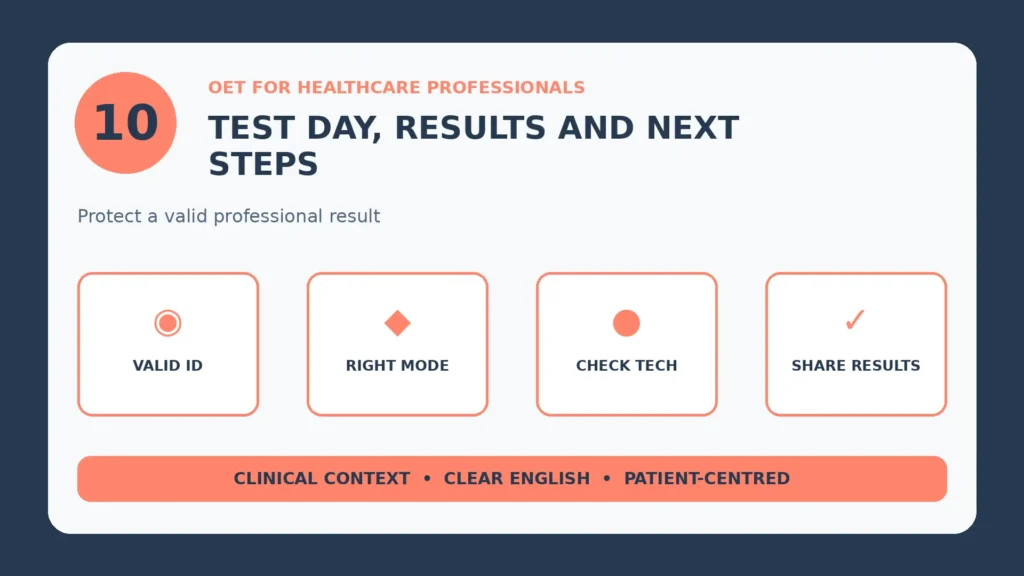
The final objective is a valid result for registration, work, study or migration. Keep account details secure, retain official correspondence and leave enough time for the receiving body to verify the score.
A practical preparation method
Begin with the correct profession-specific sample and a full diagnostic. Record Listening and Reading marks, but also classify each error: vocabulary, paraphrase, lost place, inference, spelling, instruction or time. Save a Writing response and two Speaking role plays. Assess productive work against OET’s published criteria rather than relying only on general impressions.
Use five focused sessions each week. Rotate Listening, Reading, Writing, Speaking and one mixed clinical-communication session. Build vocabulary from genuine healthcare contexts, but always connect terminology with plain-language explanations, collocations and patient-friendly alternatives. OET assesses English communication; it is not a test of how many technical words a candidate can display.
Review creates improvement. In receptive tasks, locate the evidence and explain why distractors fail. In Writing, compare every selected case-note detail with the reader’s purpose and check whether the letter is concise, organised and clinically clear. In Speaking, review empathy, questioning, structure and information-giving as well as pronunciation, fluency, grammar and vocabulary.
Complete a realistic simulation regularly in the intended delivery mode. Reproduce the section timings, reading periods, answer entry, keyboard or handwriting conditions, online role-play setup and limited opportunities to pause. Separate language weaknesses from task-process mistakes. Then correct one recurring pattern and repeat a similar task under time.
Track evidence rather than mood: raw marks, completion, timing, repeated errors and dated productive samples. In the final week, revisit proven routines, confirm identification and appointment details, complete required technology checks and protect sleep. Whenever unofficial advice conflicts with OET instructions or assessment criteria, follow OET.

Keep clinical safety in view during practice. Check names, dates, medication details, negation and requested actions carefully. Clear language is not merely an examination feature: it helps colleagues act correctly and helps patients understand, participate and make informed decisions about their care.
Quick FAQ
Is OET a medical knowledge exam?
No. It assesses English communication in healthcare contexts. Clinical familiarity helps candidates understand situations, but safe language performance is the target.
Are Writing and Speaking identical for every candidate?
No. They are tailored to the selected healthcare profession; Listening and Reading use healthcare content accessible across professions.
Is Grade B always the required result?
No. Many regulators use B or 350 as a benchmark, but requirements, combinations and validity rules vary. Check the exact authority and pathway.