
Move between clinical precision and plain English
OET vocabulary preparation should connect clinical accuracy with communication purpose. Candidates encounter terminology in Listening and Reading, but Writing and Speaking often require them to decide whether a professional term, ordinary explanation or both are appropriate for the reader or patient.
Build vocabulary in functional clusters: symptoms and history, examination, investigations, treatment, medication, risk, referral, discharge, rehabilitation and follow-up. Record collocations such as “presented with,” “responded well to,” “rule out,” “adverse effect” and “requires ongoing monitoring.” Add the grammar pattern and a complete example.
Read More: Scores, Grades and Assessment Criteria
Create plain-language pairs. “Hypertension” may need “high blood pressure”; “administer orally” may become “take by mouth”; “benign” may require “not cancerous.” Plain language must remain accurate and respectful. Avoid childish simplification or unexplained jargon.
Communication phrases deserve equal attention. Practise eliciting concerns, clarifying sequence, acknowledging emotion, explaining uncertainty, checking understanding and negotiating a plan. In Writing, learn concise ways to express chronology, current status and requested action without telegraphic fragments.
Grammar study should follow recurrent healthcare needs: tense for history and progress, passive forms for procedures, modals for advice and possibility, conditionals for safety-netting, and reference words for clear letters. Accuracy with medication, measurements, time and negation is particularly important because small language errors can change clinical meaning.
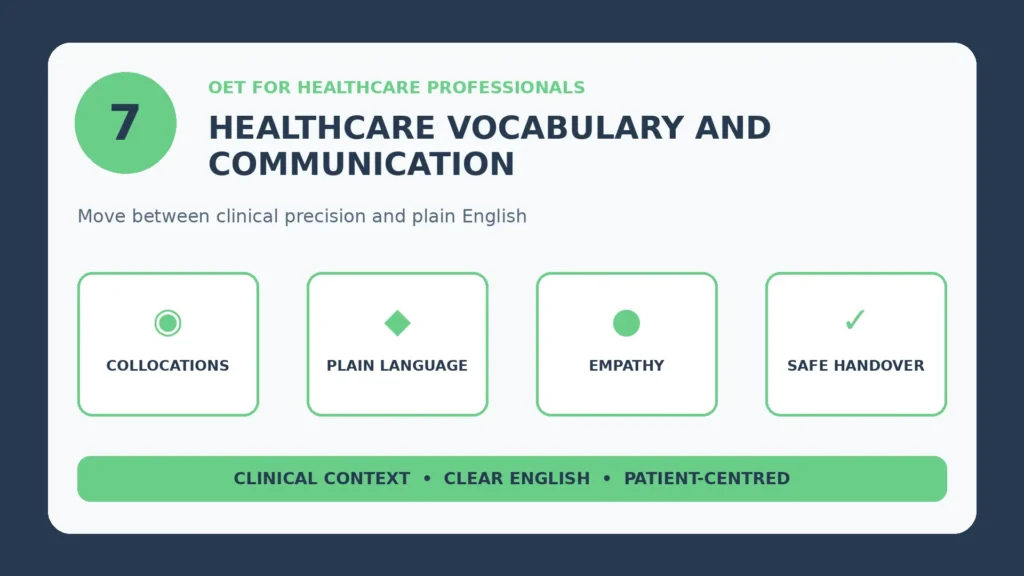
Use an error bank with original form, correction, reason and a fresh example. Retrieve language through short handovers, case-note summaries and role-play explanations rather than merely rereading lists. The goal is flexible control across audiences: a colleague needs concise clinical precision, while a patient often needs accessible explanation, reassurance and confirmation.
A practical preparation method
Begin with the correct profession-specific sample and a full diagnostic. Record Listening and Reading marks, but also classify each error: vocabulary, paraphrase, lost place, inference, spelling, instruction or time. Save a Writing response and two Speaking role plays. Assess productive work against OET’s published criteria rather than relying only on general impressions.
Use five focused sessions each week. Rotate Listening, Reading, Writing, Speaking and one mixed clinical-communication session. Build vocabulary from genuine healthcare contexts, but always connect terminology with plain-language explanations, collocations and patient-friendly alternatives. OET assesses English communication; it is not a test of how many technical words a candidate can display.
Review creates improvement. In receptive tasks, locate the evidence and explain why distractors fail. In Writing, compare every selected case-note detail with the reader’s purpose and check whether the letter is concise, organised and clinically clear. In Speaking, review empathy, questioning, structure and information-giving as well as pronunciation, fluency, grammar and vocabulary.
Complete a realistic simulation regularly in the intended delivery mode. Reproduce the section timings, reading periods, answer entry, keyboard or handwriting conditions, online role-play setup and limited opportunities to pause. Separate language weaknesses from task-process mistakes. Then correct one recurring pattern and repeat a similar task under time.
Track evidence rather than mood: raw marks, completion, timing, repeated errors and dated productive samples. In the final week, revisit proven routines, confirm identification and appointment details, complete required technology checks and protect sleep. Whenever unofficial advice conflicts with OET instructions or assessment criteria, follow OET.

Keep clinical safety in view during practice. Check names, dates, medication details, negation and requested actions carefully. Clear language is not merely an examination feature: it helps colleagues act correctly and helps patients understand, participate and make informed decisions about their care.
Quick FAQ
Is OET a medical knowledge exam?
No. It assesses English communication in healthcare contexts. Clinical familiarity helps candidates understand situations, but safe language performance is the target.
Are Writing and Speaking identical for every candidate?
No. They are tailored to the selected healthcare profession; Listening and Reading use healthcare content accessible across professions.
Is Grade B always the required result?
No. Many regulators use B or 350 as a benchmark, but requirements, combinations and validity rules vary. Check the exact authority and pathway.