
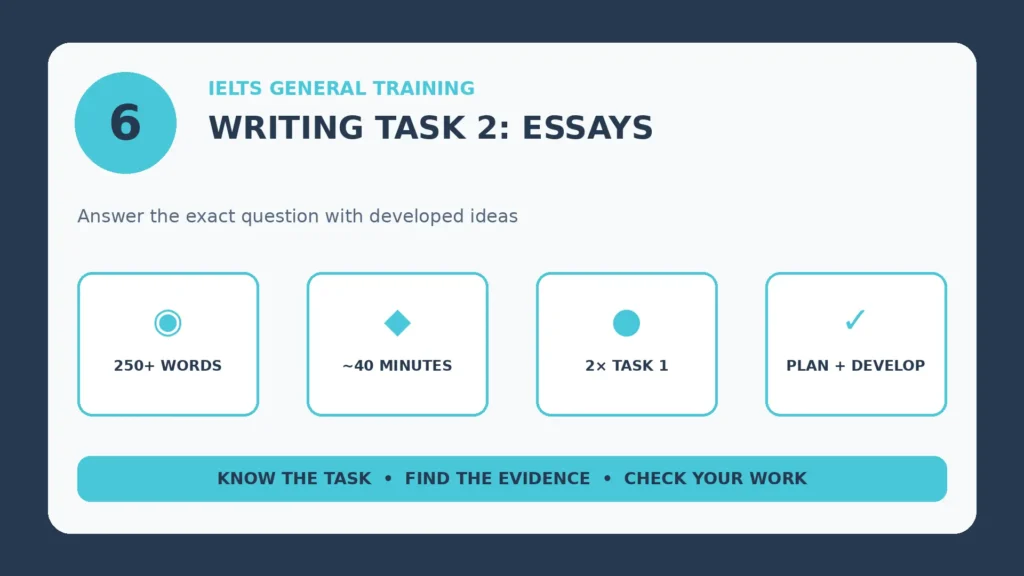
Answer the exact question with developed ideas
General Training Writing Task 2 requires an essay of at least 250 words in response to a point of view, argument or problem. IELTS recommends about 40 minutes, and the task contributes twice as much as Task 1 to the Writing result. The topics are of general interest, but a strong answer depends on reasoning rather than specialist knowledge.
Analyse the instruction before choosing ideas. “Discuss both views and give your opinion” requires a different structure from “Do the advantages outweigh the disadvantages?” Underline every demand and express your position in one clear sentence. If the position is vague in planning, it is likely to drift while writing.
Read More: Writing Task 1: Letters
Select two or three ideas that can be developed. A body paragraph should make a point, explain why it matters and support it with an example or consequence. Listing five undeveloped reasons usually produces less depth than explaining two relevant ones. Examples can be plausible and general; they do not need invented statistics.
Organise for the reader. An introduction can paraphrase the issue and state the response. Body paragraphs should have distinct controlling ideas and logical progression. The conclusion should answer the question consistently rather than introduce a new argument. Cohesion comes from clear relationships, not from inserting a memorised linker into every sentence.
Vocabulary should be accurate and appropriately varied. Avoid replacing a natural word with an obscure synonym simply to sound advanced. Grammar range can include complex sentences, but control is crucial. Mix sentence forms where they genuinely express contrast, cause, condition or qualification.
Reserve several minutes to check task completion, paragraph logic, reference words, verb forms and sentence boundaries. If time is short, complete the conclusion and repair errors that obstruct meaning rather than rewriting polished sentences. Regular timed writing, followed by criterion-based feedback and targeted rewriting, is the most dependable route to improvement.
A practical preparation method
Begin with an official-format diagnostic under time limits. Record the score, but also classify every weak answer: misunderstood instruction, vocabulary gap, lost place, inaccurate spelling, poor evidence, incomplete development or time pressure. For Writing and Speaking, save dated samples and assess them against the public band criteria. A precise error log is more useful than a vague promise to “practise more.”
Use five focused sessions each week. A balanced pattern is one Listening session, one Reading session, two productive-skill sessions and one mixed timed block. Keep vocabulary and grammar review short but frequent. Learn words in collocations and complete examples, then use them in a letter, essay or spoken answer. The purpose is flexible control, not displaying rare words.
Review correct answers that were slow or uncertain as well as wrong answers. In Listening and Reading, locate the evidence and explain why alternatives fail. In Writing, check task fulfilment first, then organisation, vocabulary and grammar. In Speaking, listen for relevance, development, fluency and intelligibility. Improve one recurring weakness, repeat a similar task, and confirm that the correction survives under time pressure.
Each week, complete one realistic simulation using the delivery mode you intend to book. Practise transferring or entering answers correctly, obey exact word limits in completion questions and leave time for checks. During the final week, revisit proven routines rather than collecting new tricks. Protect sleep, confirm identification and appointment details, and treat official IELTS guidance as the authority whenever advice conflicts.

Track progress with evidence rather than mood. Compare raw marks, completion rates, repeated error categories and dated productive samples. A difficult practice day can still be valuable when it exposes one correctable pattern and produces a clear action for the next session.
Quick FAQ
Do I need unusual vocabulary for a high band?
No. Accurate, appropriate and flexible language is more valuable than forced complexity.
Can one strong skill compensate for every weakness?
The overall band is averaged, but many organisations also impose minimum scores in individual skills. Check the exact requirement.
Should I memorise answers?
Memorised language may not address the prompt and can sound unnatural. Practise adaptable structures and genuine development instead.