
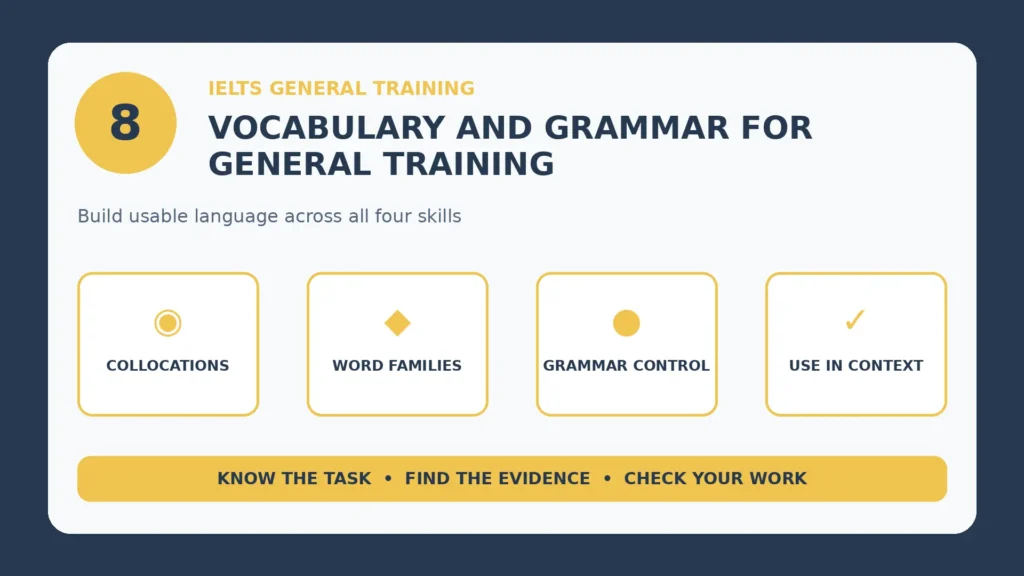
Build usable language across all four skills
IELTS does not publish a single vocabulary list that guarantees a band. General Training draws on everyday life, work, services, travel, community issues and general-interest discussion. The most efficient approach is to learn language in contexts and relationships rather than memorising isolated translations.
Build topic clusters around housing, employment, transport, health services, education, environment, technology and local community. Within each cluster, record collocations and word families: “submit an application,” “eligible for,” “reliable transport,” “environmental impact,” or “resolve a complaint.” Add one sentence that could naturally appear in a letter, essay or spoken answer.
Read More: Speaking: The Three-Part Interview
Grammar study should follow communication needs. Review tense choice for experiences and events, modals for advice and obligation, conditionals for consequences, relative clauses for description, articles and prepositions for accuracy, and complex sentences for expressing relationships. Range without control does not automatically raise a score.
Use receptive practice to feed productive language. When reading a workplace notice, collect phrases for rules and procedures. When listening to a service conversation, note polite requests and clarifications. Reuse those patterns in a Task 1 letter or Speaking response. Repeated retrieval turns recognition into control.
Create an error bank with three columns: original error, corrected form and a fresh example. Group recurring problems so that practice targets patterns rather than random sentences. Spaced review should require recall before checking, not simple rereading.
Avoid unnatural “band 9 words.” Examiners reward appropriacy, precision and flexibility. A common word used accurately in a strong collocation is better than an obscure word with the wrong tone. During timed work, choose language you can control; during review, experiment with one improved phrase or structure and verify its meaning in a reliable dictionary.
A practical preparation method
Begin with an official-format diagnostic under time limits. Record the score, but also classify every weak answer: misunderstood instruction, vocabulary gap, lost place, inaccurate spelling, poor evidence, incomplete development or time pressure. For Writing and Speaking, save dated samples and assess them against the public band criteria. A precise error log is more useful than a vague promise to “practise more.”
Use five focused sessions each week. A balanced pattern is one Listening session, one Reading session, two productive-skill sessions and one mixed timed block. Keep vocabulary and grammar review short but frequent. Learn words in collocations and complete examples, then use them in a letter, essay or spoken answer. The purpose is flexible control, not displaying rare words.
Review correct answers that were slow or uncertain as well as wrong answers. In Listening and Reading, locate the evidence and explain why alternatives fail. In Writing, check task fulfilment first, then organisation, vocabulary and grammar. In Speaking, listen for relevance, development, fluency and intelligibility. Improve one recurring weakness, repeat a similar task, and confirm that the correction survives under time pressure.
Each week, complete one realistic simulation using the delivery mode you intend to book. Practise transferring or entering answers correctly, obey exact word limits in completion questions and leave time for checks. During the final week, revisit proven routines rather than collecting new tricks. Protect sleep, confirm identification and appointment details, and treat official IELTS guidance as the authority whenever advice conflicts.

Track progress with evidence rather than mood. Compare raw marks, completion rates, repeated error categories and dated productive samples. A difficult practice day can still be valuable when it exposes one correctable pattern and produces a clear action for the next session.
Quick FAQ
Do I need unusual vocabulary for a high band?
No. Accurate, appropriate and flexible language is more valuable than forced complexity.
Can one strong skill compensate for every weakness?
The overall band is averaged, but many organisations also impose minimum scores in individual skills. Check the exact requirement.
Should I memorise answers?
Memorised language may not address the prompt and can sound unnatural. Practise adaptable structures and genuine development instead.