
When students begin planning for international education, one of the first questions they ask is simple: “Which English test should I take?”
It sounds like an easy question, but the answer can change depending on the country, university, course, visa route, and even the intake you are applying for. A student applying to the USA may compare TOEFL or IELTS for USA. A student going to Australia may search for English language test Australia or PTE vs IELTS for Australia. Someone applying to Canada may check IELTS score for Canada colleges, while a student looking at European universities may wonder how English proficiency Europe requirements work.
The truth is that there is no single English test that is best for every student. IELTS, TOEFL, PTE, and sometimes the Duolingo English Test can all be useful, but only if they match your university and visa requirements.
This university admission guide explains the major English test expectations for the USA, UK, Canada, Australia, and Europe in a practical, student-friendly way.
Read More: Academic English vs Everyday English: What International Students Must Prepare For?
Why English Tests Matter in International Student Admissions
English tests are used to prove that you can study in an English-speaking academic environment. Universities want to know that you can understand lectures, read textbooks, write assignments, join discussions, and communicate with classmates and professors.
In international student admissions, English test scores are not just formality. They can affect admission, scholarship eligibility, visa documentation, and course placement.
Most universities mention accepted tests and score requirements on their official programme pages. These may include IELTS, TOEFL, PTE, Cambridge English, or the Duolingo English Test. Some universities accept several options, while others may be stricter for specific programmes such as nursing, education, law, medicine, or postgraduate research.
This is why students should never choose a test only because a friend took it or because an agent suggested it. Good study abroad requirements planning begins with checking the official university and visa pages.

USA: TOEFL or IELTS for USA?
The USA has traditionally been one of the strongest destinations for TOEFL. Many American universities have long accepted TOEFL because it was designed around academic English and university-level communication.
However, IELTS requirements for USA are also common because many US universities now accept IELTS Academic as proof of English proficiency. Some institutions also accept PTE or Duolingo, but this varies by university and programme.
So, should you choose TOEFL or IELTS for USA?
If most of your target universities are in the USA and you are comfortable with computer-based academic tasks, TOEFL can be a strong choice. It includes reading, listening, speaking, and writing tasks that feel similar to university study. You may need to listen to a lecture, read a passage, and then respond.
IELTS can also be a good choice if you prefer its format, especially the speaking test style. Many students like IELTS because the speaking section feels more like a real interview.
For the USA, the most important point is not whether TOEFL or IELTS is “better.” The important point is whether your chosen university accepts it for your course.
Also, do not confuse university requirements with visa requirements. In many cases, the university decides whether your English score is acceptable for admission. Students often search for IELTS score for USA student visa, but English test requirements for the visa process may depend on your admission documents and individual circumstances. Always check official instructions before applying.
UK: IELTS Requirements for UK Universities and TOEFL Acceptance
The UK is strongly associated with IELTS, especially because IELTS is widely used for academic admission and UK visa-related English routes. Many students naturally search for IELTS requirements for UK or IELTS requirement for UK universities when applying.
For most UK universities, IELTS Academic is widely accepted. However, IELTS is not the only option. Many universities also accept TOEFL iBT, PTE Academic, Cambridge English, and sometimes other tests, depending on the course and level of study. Some UK universities publish equivalent scores for IELTS, TOEFL, and PTE so students can compare options. For example, UK universities often state that some courses require an IELTS score with minimum component scores, and some courses may ask for higher scores than the general requirement. (University of Surrey)
Students often ask, “Is TOEFL accepted in UK?” The answer is yes, many UK universities accept TOEFL for admission. However, students must be careful if the test is being used for visa-linked pathways, foundation courses, or pre-sessional English programmes. Some routes may require specific UKVI-approved tests or university-specific rules. One UK university advises that students joining foundation or pre-sessional English courses may need an approved UK Visas and Immigration test, so students should check their exact route carefully. (University of Portsmouth)
In short, IELTS is a very safe and popular option for the UK, but TOEFL and PTE may also work for many university admissions. The safest approach is to check both the university requirement and the visa-related requirement before booking your test.
Canada: IELTS, TOEFL, PTE, and Duolingo
Canada is one of the most popular destinations for international students, and English test requirements can depend on both university admission and visa pathway.
For university admission, Canadian colleges and universities commonly accept IELTS Academic and TOEFL iBT. Many also accept PTE, and some accept Duolingo. This is why students often search for PTE accepted in Canada or Duolingo accepted in Canada universities.
However, the important thing to remember is that university admission and immigration requirements are not always the same.
For example, students may search for Canada SDS IELTS requirement because the Student Direct Stream has had specific language test rules. Canada’s official immigration guidance has listed language test requirements for SDS, including IELTS score expectations by language ability. (Canada) Because immigration rules can change, students should always check the official Canadian government website before relying on older information.
For university admission, the IELTS score for Canada colleges may vary by institution and programme. A diploma programme may have one requirement, while a postgraduate certificate, nursing programme, or master’s degree may ask for a higher score.
For Canada, students should ask two separate questions:
Which test does my university or college accept?
Which test is accepted for my visa or immigration pathway?
If one test works for both, that can make planning easier. If not, you may need to make a careful decision.
Australia: IELTS, PTE, TOEFL, and Visa Rules
Australia is a major destination where English test planning is very important. Students often search for English language test Australia, IELTS requirement Australia student visa, PTE score for Australia, PTE vs IELTS for Australia, and australia student visa english test.
For Australian universities, IELTS Academic, TOEFL iBT, and PTE Academic are commonly accepted, but exact scores vary by institution and course. Some courses, especially healthcare, education, and professional registration pathways, may require higher scores.
For visa purposes, students must follow the official rules of Australia’s Department of Home Affairs. The department lists accepted English tests and score requirements for different English levels. It also explains that for TOEFL iBT results to be valid for Australian visa purposes, applicants must select the correct “Taking TOEFL for Australia” pathway when registering, and that ordinary results not registered under that pathway are not eligible for Australian visa purposes. (Immigration and citizenship Website)
This detail is extremely important. A student may take the right test but register in the wrong way, causing problems later.
Australia is also a country where many students compare PTE vs IELTS. PTE is popular because it is computer-based and widely used for Australian study and migration pathways. IELTS remains widely recognised and accepted. The better choice depends on your university, visa type, test comfort, and score target.
For Australia, do not rely only on general advice. Always check both university admission and student visa English test rules.
Europe: English Proficiency Requirements Vary Widely
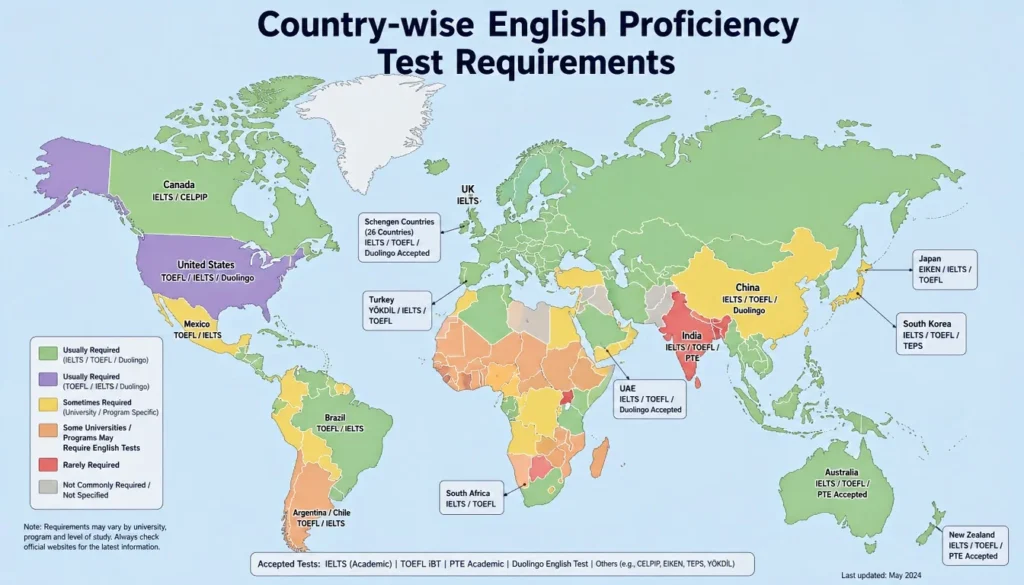
Europe is different because it includes many countries, education systems, and languages. When students search for English proficiency Europe, they may be looking at Germany, France, Netherlands, Ireland, Sweden, Finland, Italy, Spain, Poland, or other destinations.
Many European universities offer English-taught programmes, especially at master’s level. These programmes often require proof of English proficiency through IELTS, TOEFL, PTE, Cambridge English, or previous education in English.
However, requirements vary widely. Some universities may accept a medium-of-instruction letter if your previous education was in English. Others may insist on an official English proficiency exam. Some countries may be flexible for university admission but stricter for visa or residence permit documentation.
Ireland is usually closer to UK-style English requirements because English is the main language of instruction. Countries like Germany, Netherlands, Sweden, and Finland often publish clear English proficiency requirements for international programmes, but accepted tests and scores differ by university.
For Europe, the key is to check the exact programme page. Do not assume one rule applies across the whole continent.
IELTS vs TOEFL vs PTE: Which One Should You Choose?
Students often compare IELTS vs TOEFL vs PTE because all three are widely recognised. Each test has a different style.
IELTS may suit students who prefer a traditional academic test format and, in many places, a speaking test with a human examiner. It is widely accepted in the UK, Canada, Australia, Europe, and the USA.
TOEFL may suit students applying mainly to US universities or students comfortable with computer-based academic tasks. It is also accepted in many other countries.
PTE may suit students who prefer a fully computer-based test and quick digital scoring. It is popular for Australia and is accepted in several countries. Students searching for PTE accepted countries should check both university and visa rules because acceptance can vary.
The question which english test is easier does not have one fixed answer. IELTS may feel easier if you like face-to-face speaking. TOEFL may feel easier if you like structured academic tasks and typing. PTE may feel easier if you are comfortable with computer-based testing and quick responses.
The easiest test is usually the one that matches your strengths and is accepted by your target universities.
IELTS vs Duolingo
Many students also compare IELTS vs Duolingo. The Duolingo English Test is shorter, online, and often more affordable. Some universities accept it for admission, including institutions in Canada, the USA, the UK, and Europe.
However, Duolingo is not accepted everywhere. It may also be accepted for admission but not for visa purposes or certain professional programmes. Some UK universities have recently expanded Duolingo acceptance, but there has also been debate about how well it measures deeper academic language skills. (Financial Times)
IELTS, on the other hand, is longer established and widely recognised across university and visa systems. If you need maximum flexibility, IELTS may be safer. If your selected universities clearly accept Duolingo and your visa route allows it, Duolingo can be convenient.
Again, do not choose based only on convenience. Choose based on acceptance.
Role of Abroad Education Consultants
Many students work with abroad education consultants to understand test requirements, university options, documents, and visa timelines. A good consultant can help you avoid mistakes, especially when requirements differ by country.
However, students should still verify important information themselves. Consultants can guide you, but official university and government websites should be treated as the final source.
This is especially true for English tests because accepted exams, score requirements, and visa rules may change.
Common Mistakes Students Should Avoid
One common mistake is choosing a test before checking university requirements. This can waste time and money.
Another mistake is assuming that a test accepted for admission is automatically accepted for visa purposes. This is not always true.
A third mistake is ignoring section-wise scores. Many universities require both overall and component scores.
Some students also rely on old information from forums, friends, or social media. Requirements change, so old advice may be misleading.
Another mistake is applying to several countries with one test plan without checking compatibility. If you are applying to the USA, Canada, and Australia together, choose a test accepted across most of your target universities and visa routes.
Final Thoughts
Choosing the right English test is one of the most important early steps in your study abroad journey.
For the USA, TOEFL and IELTS are both strong options, with TOEFL traditionally popular among American universities. For the UK, IELTS is widely used, but TOEFL and PTE may also be accepted by many universities. For Canada, IELTS, TOEFL, PTE, and sometimes Duolingo may work for admission, but immigration pathways need separate checking. For Australia, IELTS, PTE, and TOEFL are common, but visa rules must be followed carefully. For Europe, requirements vary widely by country and university.
The best test is not simply the easiest test. It is the test that fits your country, university, course, visa route, deadline, and personal strengths.
Use this university admission guide as a starting point. Then check the official pages. That one extra step can save you from delays, rejected scores, and unnecessary stress.
Studying abroad is already a big journey. Choosing the right English test makes the path much clearer.
FAQs
1. Which English test is best for studying in the USA?
For the USA, both TOEFL and IELTS are widely accepted by many universities. TOEFL is traditionally popular for US admissions, but IELTS is also accepted by many institutions. Always check the exact requirements of your chosen university and programme.
2. Is TOEFL accepted in UK universities?
Yes, many UK universities accept TOEFL for admission. However, some visa-linked routes, foundation courses, or pre-sessional English programmes may require specific approved tests. Check both university and UK visa-related requirements before booking.
3. What English test is required for Australia student visa?
Australia accepts specific English tests for visa purposes, including IELTS, PTE, TOEFL iBT, and others depending on the visa rules. Requirements can vary, and TOEFL applicants must follow the correct registration pathway for Australia. Always check the official Department of Home Affairs website.
4. Is Duolingo accepted in Canada universities?
Some Canadian universities accept the Duolingo English Test for admission, but not all do. It may also not be suitable for every visa or immigration pathway. Students should check their university’s official admission page and government visa requirements.
5. Which is easier: IELTS, TOEFL, or PTE?
There is no single easiest test for everyone. IELTS may suit students who prefer human speaking tests, TOEFL may suit students comfortable with academic computer-based tasks, and PTE may suit students who like fully digital testing. The best choice depends on acceptance and personal strengths.





Leave a Reply