
How the Speaking section works since January 2026
The TOEFL iBT changed on 21 January 2026, and Speaking changed more than any other section. It now has two task types, Listen and Repeat and Take an Interview, with 11 items in about 8 minutes. The older format, with an independent opinion task and integrated tasks built on readings and lectures, is no longer part of the test. Many books, videos and response templates still describe that older format, so check the date of any material you use.
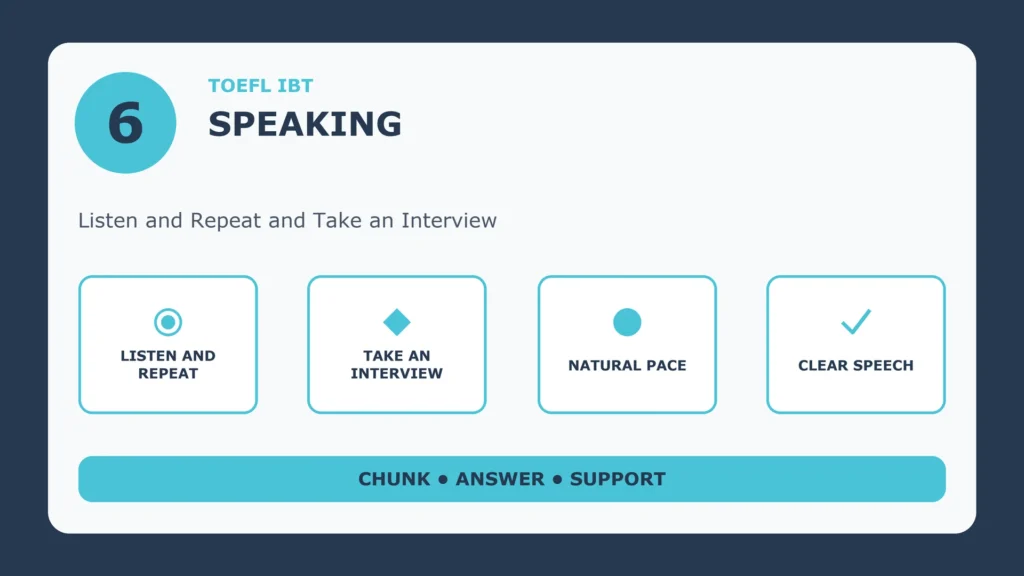
Task 1: Listen and Repeat
You listen to short sentences and repeat them exactly as you hear them. ETS says this task measures your ability to process spoken English and produce speech that is accurate and clearly intelligible.
What goes wrong
- Paraphrasing instead of repeating. This is not a summary task: say the sentence, not your version of it.
- Dropping small words such as articles, prepositions and auxiliary verbs.
- Rushing, which blurs word endings like -ed and -s.
How to prepare
- Listen in chunks. Hear the sentence as meaningful groups of words rather than single words.
- Copy the rhythm. English stresses content words and reduces small words; matching that pattern makes repetition easier to remember and easier to understand.
- Shadow short recordings. Play a sentence, pause, repeat it, then compare your recording with the original.
- Build listening vocabulary. It is much easier to repeat words you already recognise quickly.
Task 2: Take an Interview
You take part in a simulated interview related to academic or campus situations, answering questions about your experiences and opinions. ETS says this task measures your ability to communicate clearly, keep a natural speaking pace, and use appropriate vocabulary and grammar.
What goes wrong
- Very short answers that give no reason or detail.
- Memorised templates that do not answer the actual question.
- Speaking too fast to sound fluent, which reduces clarity.
How to prepare
- Answer first, then support. Give a direct answer, one reason and a short example.
- Practise common campus and study topics: classes, study habits, campus services, group projects, technology in learning.
- Aim for a natural pace. Short pauses between ideas are normal; long silences and fillers are not.
- Respond within the time shown on screen, and practise finishing your idea rather than stopping mid-sentence.
How Speaking is scored
Each TOEFL iBT section, including Speaking, receives a score on a 1–6 scale in half-point increments. Your overall score is the average of the four sections, rounded to the nearest half band. For a two-year transition period after January 2026, score reports also include a comparable overall score on the familiar 0–120 scale.
A weekly practice routine
- Three short shadowing sessions: 10 minutes each of listen, pause, repeat and compare.
- Two interview sessions: answer five questions on a campus topic, record them and check whether each answer has a clear point and support.
- One review session: listen for repeated fillers, dropped word endings and unclear stress, and choose one habit to fix next week.

Quick FAQ
Are the old TOEFL speaking templates still useful? Not for the current tasks. They were built for independent and integrated tasks that ETS no longer describes in the Speaking section.
Do I still summarise a reading and a lecture when speaking? No. The current Speaking section consists of Listen and Repeat and Take an Interview.
Is Speaking still about 17 minutes? No. ETS lists about 8 minutes for the current Speaking section, and timing can vary slightly because the test adapts.
Official ETS sources
Accuracy note (14 September 2026): this article reflects the TOEFL iBT format introduced in January 2026. Check ets.org for the latest details before your test.
Ready for structured practice? See the TOEFL iBT course.