
Read for structure, then go back for detail
Reading Comprehension is the second question type in Verbal Reasoning. Each passage, a few paragraphs on a topic in business, science, social science or the humanities, comes with several questions, and the passage stays on screen while you answer them.
Questions ask about the main idea, specific details, what can be inferred, why the author includes a particular point, and how the argument is organised. Some ask you to apply an idea from the passage to a new situation.
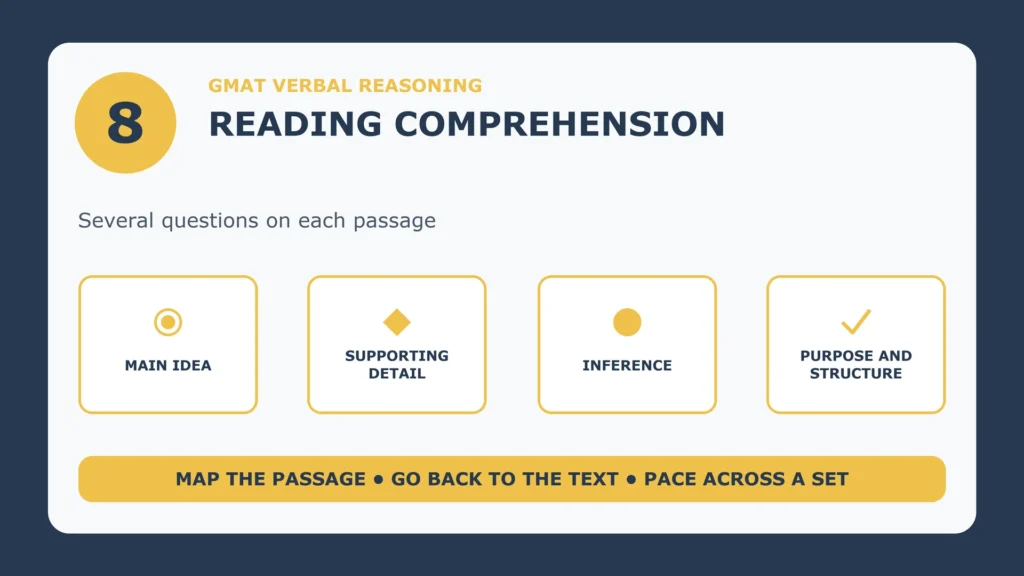
Because the passage stays visible, you do not need to memorise it. The skill is to understand its structure on the first read, so you know where to look when a question asks about a detail.
Read More: GMAT Critical Reasoning: Question Types and Method
An efficient way to read
On the first read, note in a few words what each paragraph does: introduces a view, gives evidence, raises an objection, offers a conclusion. Notice the author’s own position and any contrast words such as however, yet and although.
For each question, go back to the text. The right answer is supported by specific lines; wrong answers often use words from the passage but change the meaning, go further than the author, or describe the wrong part.
Pace a whole passage, not single questions. Reading takes time at the start, then the questions go faster. If a set is running long, make your best choice and move on; the Verbal average is about 1 minute 57 seconds per question across the section.

Read widely outside practice: long-form articles on economics, science and history build the reading stamina that the GMAT assumes. Then summarise each one in a sentence, as you would on test day.
Quick FAQ
Can I see the passage while answering?
Yes. The passage stays on screen for all the questions about it.
Do I need subject knowledge?
No. Answer only from the passage, even when the topic is familiar.
How long are the passages?
They vary. Practise with official passages so the length and density feel normal.
Official GMAT sources
Ready for structured practice? See the GMAT course.