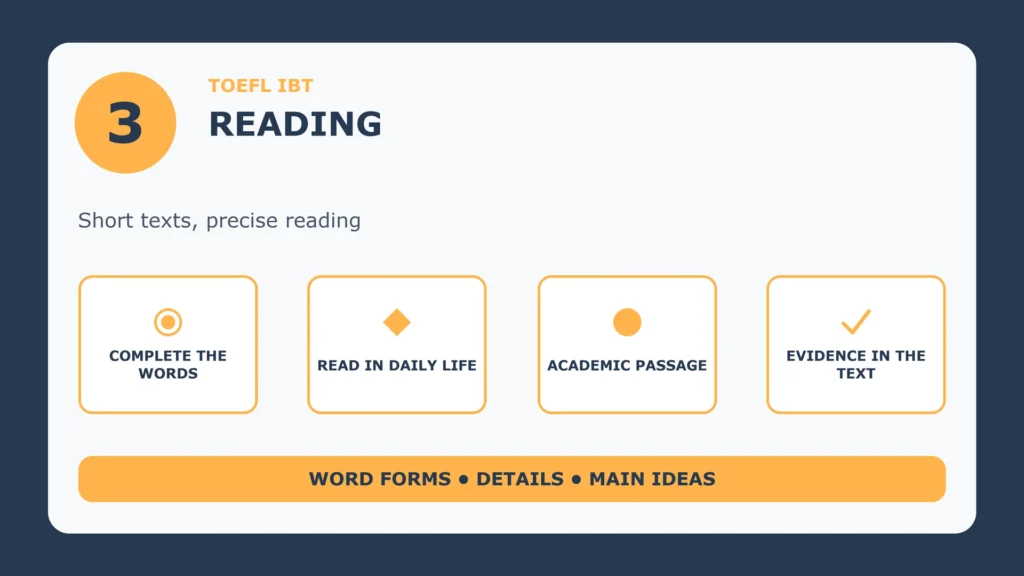
Short texts, precise reading
The TOEFL iBT Reading section has about 50 items in about 30 minutes, across three task types. Texts are concise, and ETS notes that everything you need to answer is in the text. The section adapts to your level, so the exact number of items and the time can vary.
Task 1: Complete the Words
You complete partially missing words in a short text. ETS says this measures your vocabulary knowledge and your ability to understand meaning from context.
How to approach it
- Read the whole sentence before completing a word.
- Decide what the gap needs: a noun or verb, a past tense, a plural, an adverb.
- Check spelling carefully, including double letters and word endings.
How to practise
- Take short academic paragraphs, blank out the second half of several words, and complete them a day later.
- Study word families: analyse, analysis, analytical, analytically.
Task 2: Read in Daily Life
You read short everyday texts, such as notices, messages or short informational texts. Questions test main ideas, key details and implied meaning.
How to approach it
- Ask who wrote it, who it is for, and what the reader should do.
- Watch for dates, times, conditions and exceptions.
- For implied meaning, ask why the message was written, not only what it says.
How to practise
- Read real campus-style notices, emails and announcements in English and summarise each in one sentence.
Task 3: Read an Academic Passage
You read a short academic passage similar to university course material. Questions test main ideas, supporting details and important vocabulary.
How to approach it
- Note the purpose of each paragraph as you go (definition, example, contrast, cause).
- Find the sentence that supports your answer before you choose it.
- Don’t answer from your own knowledge of the topic.
How to practise
- Read short science, history and social science texts and write a one-line summary of each paragraph.
- Build academic vocabulary from what you read, with the collocations it appears in.
Managing the section
- Keep moving. Short texts reward steady, careful reading, not rushing and not getting stuck.
- Expect the level to change. The test adapts, so harder items don’t mean you are doing badly.
- Review errors by task type so you know whether vocabulary, detail or inference is costing you most.
Common mistakes
- Completing a word so it looks right but doesn’t fit the grammar of the sentence.
- Missing a condition such as only, except or unless in an everyday text.
- Choosing an answer that is true in general but not stated in the passage.

Quick FAQ
Are there still long reading passages? The current section uses short texts and a short academic passage.
How is Reading scored? Reading receives a section score on the 1–6 scale, which feeds into your overall score.
Official ETS sources
Accuracy note (15 September 2026): this article reflects the TOEFL iBT format introduced in January 2026.