
Know every section and task before test day
The TOEFL iBT format changed in January 2026. The four sections now use short, focused tasks, and Reading and Listening adapt to your level as you work. This guide sets out what each section contains, how long it takes, and how the adaptive design affects your timing.
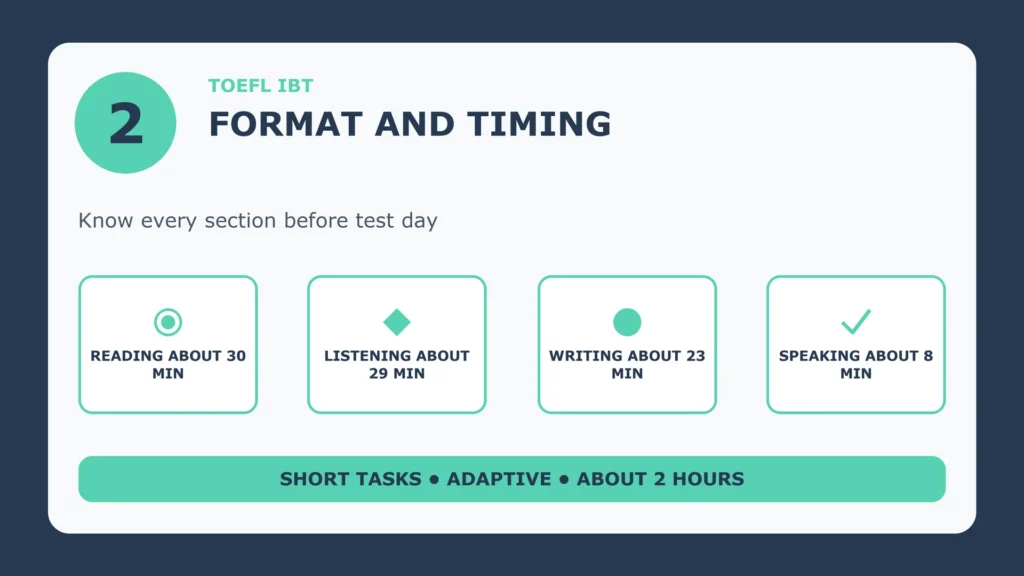
The four sections
| Section | Items | Time | What it measures |
|---|---|---|---|
| Reading | 50 | About 30 minutes | Understanding everyday and academic texts |
| Listening | 47 | About 29 minutes | Understanding spoken English on campus and in academic talks |
| Writing | 12 | About 23 minutes | Building correct sentences and writing for a purpose |
| Speaking | 11 | About 8 minutes | Clear, accurate and natural spoken English |
The sections add up to about 90 minutes. ETS recommends allowing about two hours in total, including check-in.
Reading tasks
- Complete the Words: fill in partially missing words in a short text. Tests vocabulary and understanding meaning from context.
- Read in Daily Life: short everyday texts such as notices, messages or short informational texts.
- Read an Academic Passage: a short passage similar to university course reading.
Listening tasks
- Listen and Choose a Response: hear a short spoken prompt and choose the best reply.
- Listen to a Conversation: mainly about campus life.
- Listen to an Announcement: in an academic or campus setting.
- Listen to an Academic Talk: a short talk by a professor or expert.
Writing tasks
- Build a Sentence: arrange words or phrases into a correct sentence or question.
- Write an Email: for an academic or social purpose, such as making a request or proposing a solution.
- Write for an Academic Discussion: state and support your opinion in an online class discussion.
Speaking tasks
- Listen and Repeat: repeat short sentences exactly as you hear them.
- Take an Interview: answer questions about your experiences and opinions in a simulated interview.
What “adaptive” means for you
As the test adjusts to your level, the items you see, and sometimes the number of items and the time, can change. In practice:
- Don’t read difficulty as failure. Harder questions can simply mean the test is placing you accurately.
- Use the on-screen timer, not a fixed plan based on someone else’s test.
- Keep a steady pace rather than spending too long on any single item.
What changed from the old format
- Long reading passages and long lectures gave way to shorter, more varied tasks.
- The integrated essay and independent essay were replaced by Build a Sentence, Write an Email and Write for an Academic Discussion.
- The four-task Speaking section was replaced by Listen and Repeat and Take an Interview.
- Scores moved to a 1–6 scale, with a comparable 0–120 overall score during the two-year transition.

Quick FAQ
Can I use pre-2026 practice books? They can still help with general academic English, but their task types, timing and scoring don’t match the current test.
Is there a break? Follow the instructions given for your delivery option. For the at-home test, ETS states that taking a break invalidates your test.
Official ETS sources
Accuracy note (15 September 2026): this article reflects the TOEFL iBT format introduced in January 2026. Timings and item counts can vary because the test is adaptive.