
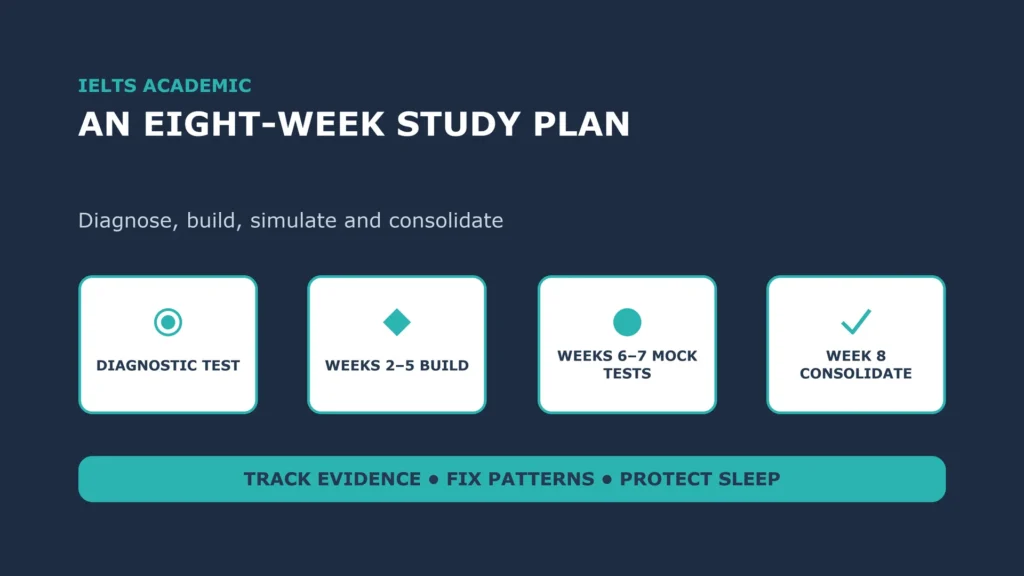
Diagnose, build, simulate and consolidate
An eight-week IELTS Academic plan gives structure without pretending every learner starts at the same level. Begin by confirming two things with the organisation you are applying to: that it accepts IELTS Academic in the delivery mode you plan to use, and which overall and section scores it requires. Then take a full practice test under timed conditions to find your starting point.
Before Week 1: the diagnostic
Complete all four skills in one sitting if you can, because the real test lasts 2 hours and 45 minutes.
- Listening: four parts, 40 questions, about 30 minutes, each recording heard once.
- Reading: three sections, 40 questions, 60 minutes.
- Writing: Task 1 (at least 150 words, no more than 20 minutes) and Task 2 (at least 250 words, no more than 40 minutes).
- Speaking: a recorded 11–14-minute interview in three parts. Ask a teacher or study partner to play the examiner.
Record your Listening and Reading raw marks and classify every error: vocabulary, paraphrase, lost place, spelling, instructions or time. Save both Writing answers and the Speaking recording. These are your baseline evidence.
Week 1: map the test
Learn what each part asks for. Study the question types: Listening has six, including map and diagram labelling, and Reading has eleven, including True/False/Not Given and matching headings. Read the Writing and Speaking assessment criteria so you know what “good” looks like. Start an error log and a vocabulary notebook organised by topic.
Weeks 2–3: build foundations
- Listening: one part a day. Practise predicting the answer type before the audio starts, and check spelling against word limits.
- Reading: one passage a day. Locate the evidence for every answer, and explain why each wrong option fails.
- Writing: Task 1 overviews and comparisons; Task 2 paragraph structure. Write shorter pieces and correct them carefully.
- Speaking: Part 1 answers with a reason or example; one-minute preparation notes for Part 2.
Weeks 4–5: develop task control
Move from single parts to full sections. Complete a whole Reading test in 60 minutes and a full Listening test in one sitting. Write complete Task 1 and Task 2 answers within 20 and 40 minutes. Remember that Task 2 counts twice as much as Task 1, so protect its time. In Speaking, practise the 2-minute Part 2 talk and longer Part 3 discussions on abstract topics. Use your error log to choose one grammar or vocabulary target each week.
Weeks 6–7: full simulations
Take at least one complete practice test each week in the mode you will use: paper, computer, or IELTS Online. Match the real conditions, including typing or handwriting, answer entry and the time of day. Afterwards, separate language weaknesses from process mistakes such as running out of time, skipping instructions or transferring answers wrongly. Fix one recurring pattern, then repeat a similar task under time.
Week 8: consolidate
Stop adding new strategies. Repeat selected weak tasks, review your most frequent errors and keep one light Speaking session to stay fluent. Confirm your booking, test venue or online setup, and the identification you must bring. Protect sleep in the final days: tired candidates lose easy marks.
A sustainable weekly rhythm
Five focused sessions and one light review day work well for most learners. Each session should produce something you can check later: corrected answers, a rewritten paragraph, an updated error log or a re-recorded Speaking answer. Track evidence rather than mood: raw marks, timing, repeated errors and dated writing samples.
If progress stalls
Doing more full tests will not fix a specific weakness. If Reading marks are flat, check whether the problem is paraphrase recognition, time or instructions. If Writing is stuck, compare your answer with the band descriptors one criterion at a time. Practise the smaller skill, get reliable feedback, then return to timed work.

Quick FAQ
Is eight weeks enough? It depends on your starting level and target. Eight weeks can build strong exam control, but a large gap between your diagnostic and your required score may need a longer plan.
How many practice tests should I take? Quality matters more than number. One carefully reviewed test teaches more than three that are only scored.
Should I practise on computer or paper? Practise in the mode you have booked, especially in Weeks 6–7.
Official IELTS sources
- IELTS Academic test format
- IELTS Academic Listening format
- IELTS Academic Reading format
- IELTS Academic Writing format
- IELTS Academic Speaking format
- IELTS Academic sample test questions
Accuracy note (14 September 2026): test formats, delivery options and organisations’ requirements can change. Confirm current details on ielts.org and with every organisation you apply to.