
Build language the examiners can actually reward
IELTS does not publish a word list that guarantees a band score, and no grammar structure earns marks simply by appearing on the page. What the test rewards is language that communicates precisely. In Writing and Speaking, two of the four assessment criteria are about language itself: Lexical resource and Grammatical range and accuracy. In Listening and Reading, vocabulary decides how quickly you recognise that a question has paraphrased what you heard or read.
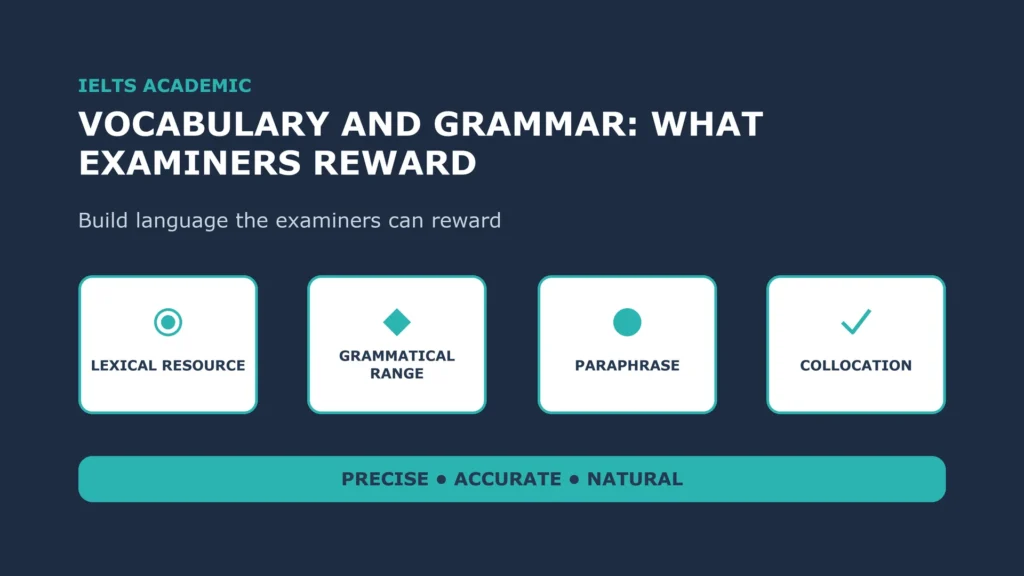
What the criteria look for
Lexical resource is about range and control. A wide vocabulary helps only when each word fits its meaning, its collocations and its register. “The number of cars rose sharply” is stronger than an impressive-sounding word used slightly wrongly.
Grammatical range and accuracy rewards a mix of sentence structures used correctly. Complex sentences show range, but frequent errors in them lower accuracy. A clear simple sentence is better than a broken complex one.
The other criteria depend on language too. Writing is also marked for Task achievement (Task 1) or Task response (Task 2) and for Coherence and cohesion. Speaking is also marked for Fluency and coherence and for Pronunciation. Weak vocabulary makes it harder to develop ideas; weak grammar makes it harder to connect them.
Vocabulary for Reading and Listening
Academic Reading has three sections, 40 questions and 2,150–2,750 words in total. The texts come from books, journals, magazines, newspapers and online sources written for a non-specialist audience. You do not need subject knowledge, but you do need to recognise the same idea expressed in different words.
- Build synonym and word-family sets: rise, increase, growth, expand; significant, considerable, marked.
- Notice qualifiers and negatives that change meaning: rarely, largely, not entirely, fewer than. Many True/False/Not Given and Yes/No/Not Given errors come from missing one of these words.
- Learn academic linking language (whereas, nevertheless, as a result) so you can follow an argument’s direction.
In Listening, completion questions carry word limits such as “NO MORE THAN TWO WORDS AND/OR A NUMBER”. Practise writing exactly what you hear: singular or plural, numbers, dates and spelling.
Vocabulary for Writing
Task 1 asks you to describe visual information in at least 150 words. Build clusters for trends (climb, dip, level off, fluctuate), comparison (twice as many, slightly lower than), proportion (a quarter, the majority), processes (is heated, is then filtered) and maps (was replaced by, was extended).
Task 2 asks you to discuss a point of view, argument or problem in at least 250 words. Build language for stance (I would argue that), concession (although this is true), cause and effect (this leads to) and hedging (tends to, may partly explain). Learn phrases as flexible patterns, not memorised sentences: examiners notice prepared language that does not fit the question.
Grammar that carries meaning
- Tense control: past tenses for historical data, future forms for projections, present tenses for processes and general claims.
- The passive for processes and for focusing on results rather than people.
- Relative, conditional and concessive clauses to show relationships between ideas.
- Accuracy basics: subject–verb agreement, articles, countable and uncountable nouns, and punctuation between clauses.
Both Writing tasks must be written in full sentences. Notes or bullet points are penalised, so practise turning outline notes into connected paragraphs.
Vocabulary and grammar in Speaking
Speaking is a recorded interview of 11–14 minutes in three parts. When you do not know a word, paraphrase: the thing you use to… keeps you fluent. Use idiomatic language only when it sounds natural for you. Mix short and longer sentences, and correct yourself briefly if you notice an error. Self-correction is normal communication.
A practical preparation method
- Keep an error log with categories: word choice, collocation, word form, tense, articles, agreement, sentence boundaries.
- Study by topic cluster. Education, environment, technology, health, work and cities appear across Writing and Speaking. For each new word, record its collocations, its other forms and one sentence of your own.
- Rewrite, don’t just write more. Once a week, correct and rewrite one Task 1 and one Task 2 paragraph using your error log.
- Record and transcribe one Speaking answer a week. Mark repeated words and grammar slips, then say the answer again.
- Read like a writer. When a Reading passage explains an idea well, copy one useful phrase into your topic notes.

Quick FAQ
Should I use rare or advanced words? Only when you are sure of their meaning and use. Precision is rewarded; misused words are not.
Are simple sentences a problem? No. A variety of structures shows range, but accuracy matters too. Aim for clear sentences first, then add complexity you can control.
Is there an official vocabulary list? No. Build vocabulary from academic-style reading and the topics that commonly appear in the test.
Official IELTS sources
- IELTS Academic test format
- IELTS Academic Reading format
- IELTS Academic Writing format
- IELTS Academic Speaking format
- IELTS Writing band descriptors (PDF)
Accuracy note (14 September 2026): test formats and assessment criteria can change. Check the current information on ielts.org before your test.