
Know the complete route before test day
IELTS General Training contains four skills with distinct time pressures. Listening has four parts and 40 questions in about 30 minutes. Reading has three sections, 40 questions and 60 minutes including transfer time. Writing gives 60 minutes for two tasks. Speaking is an 11–14-minute interview in three parts.
Listening progresses through social and educational situations. Questions follow the order of the recording, but each recording is heard once. Reading moves from everyday survival material to workplace texts and then a longer general-interest passage. Its total text length is approximately 2,150–2,750 words. The question types can include multiple choice, matching, headings, True/False/Not Given, sentence or summary completion and short answers.
Read More: What IELTS General Training Is?
Writing Task 1 requires at least 150 words, normally in about 20 minutes. The candidate writes a personal, semi-formal or formal letter and covers three bullet points. Task 2 requires at least 250 words and about 40 minutes. It carries twice the weight of Task 1, so running out of time for the essay is especially costly.
Speaking Part 1 asks familiar questions, Part 2 uses a task card with preparation time and an extended turn, and Part 3 develops a broader discussion connected with the Part 2 topic. The examiner follows a standardised procedure while responding as a real conversational partner.
Listening and Reading award one mark per correct answer, then convert raw marks to whole or half bands. Exact conversion can vary slightly by test version. Writing is judged on Task Achievement or Task Response, Coherence and Cohesion, Lexical Resource, and Grammatical Range and Accuracy. Speaking uses Fluency and Coherence, Lexical Resource, Grammatical Range and Accuracy, and Pronunciation.
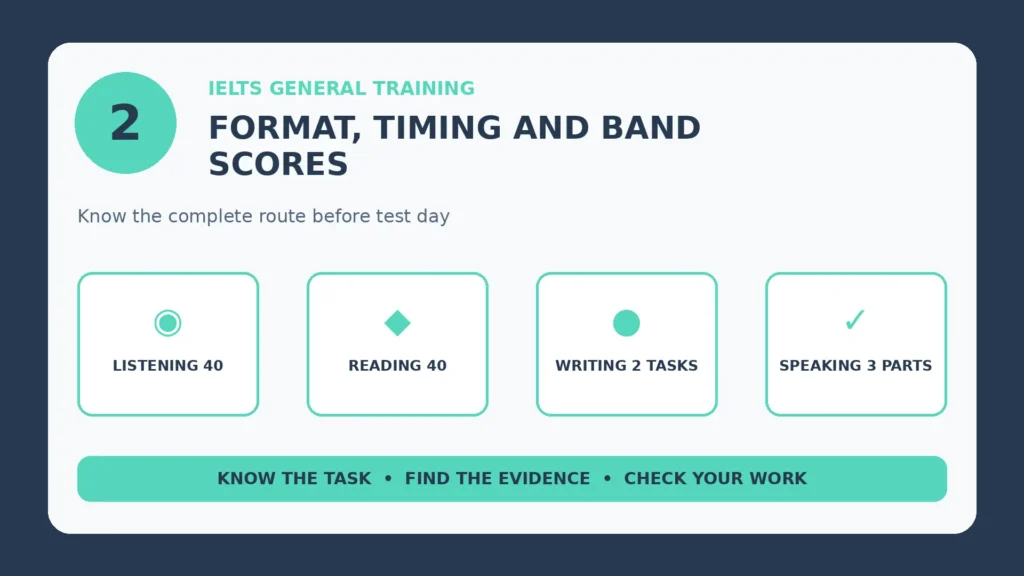
Learn the format as a sequence of decisions: read the instruction, recognise the task type, select an evidence or planning strategy, answer in the required form and check. Familiarity should reduce administrative errors and preserve attention for English.
A practical preparation method
Begin with an official-format diagnostic under time limits. Record the score, but also classify every weak answer: misunderstood instruction, vocabulary gap, lost place, inaccurate spelling, poor evidence, incomplete development or time pressure. For Writing and Speaking, save dated samples and assess them against the public band criteria. A precise error log is more useful than a vague promise to “practise more.”
Use five focused sessions each week. A balanced pattern is one Listening session, one Reading session, two productive-skill sessions and one mixed timed block. Keep vocabulary and grammar review short but frequent. Learn words in collocations and complete examples, then use them in a letter, essay or spoken answer. The purpose is flexible control, not displaying rare words.
Review correct answers that were slow or uncertain as well as wrong answers. In Listening and Reading, locate the evidence and explain why alternatives fail. In Writing, check task fulfilment first, then organisation, vocabulary and grammar. In Speaking, listen for relevance, development, fluency and intelligibility. Improve one recurring weakness, repeat a similar task, and confirm that the correction survives under time pressure.
Each week, complete one realistic simulation using the delivery mode you intend to book. Practise transferring or entering answers correctly, obey exact word limits in completion questions and leave time for checks. During the final week, revisit proven routines rather than collecting new tricks. Protect sleep, confirm identification and appointment details, and treat official IELTS guidance as the authority whenever advice conflicts.

Track progress with evidence rather than mood. Compare raw marks, completion rates, repeated error categories and dated productive samples. A difficult practice day can still be valuable when it exposes one correctable pattern and produces a clear action for the next session.
Quick FAQ
Do I need unusual vocabulary for a high band?
No. Accurate, appropriate and flexible language is more valuable than forced complexity.
Can one strong skill compensate for every weakness?
The overall band is averaged, but many organisations also impose minimum scores in individual skills. Check the exact requirement.
Should I memorise answers?
Memorised language may not address the prompt and can sound unnatural. Practise adaptable structures and genuine development instead.