
Use grammar, cohesion and evidence
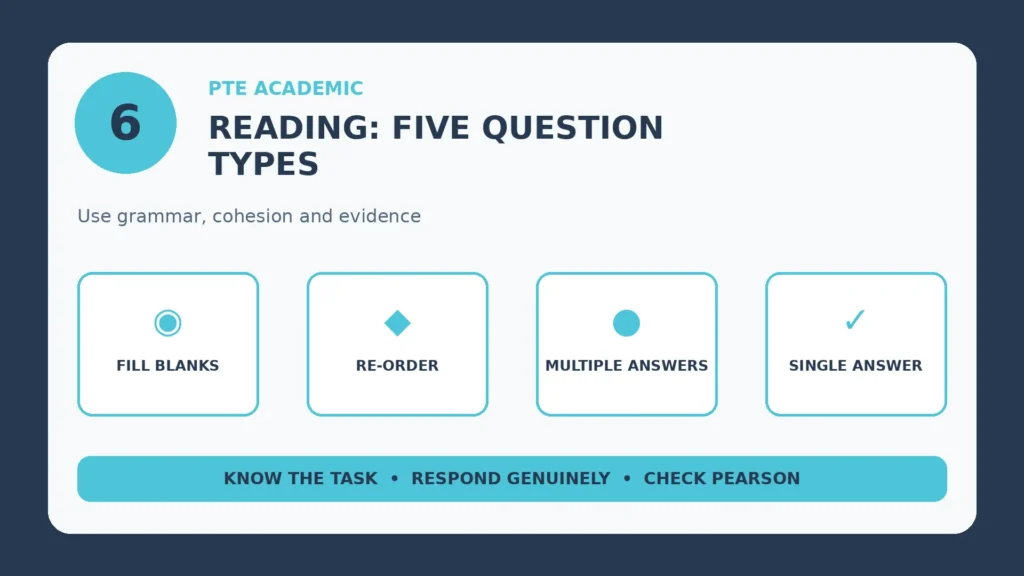
The Reading part currently lasts approximately 23–30 minutes and contains five question types. These are Reading and Writing: Fill in the Blanks, Multiple Choice Multiple Answers, Re-order Paragraphs, Reading: Fill in the Blanks and Multiple Choice Single Answer. The short section makes efficient decisions essential.
For both fill-in-the-blank types, combine meaning with grammar and collocation. Identify the required part of speech, agreement and surrounding prepositions before comparing vocabulary options. Read the completed sentence and its neighbouring context; a word can fit locally but damage the paragraph’s meaning.
Read More: Writing: Summaries and Essays
Re-order Paragraphs tests cohesion. Look for an independent opening, then track reference words, repeated concepts, chronology, cause and contrast. Articles and pronouns can reveal whether a noun has already been introduced. Build reliable pairs first, then assemble the complete sequence rather than moving every box repeatedly.
Multiple Choice Multiple Answers requires caution because incorrect selections can attract negative marking in applicable PTE tasks. Select only options supported by the text rather than clicking every plausible statement. In single-answer items, distinguish the central message from a true but minor detail.
Reading speed should vary. Skim to identify purpose and organisation, scan for a specific feature, and read closely when testing inference or cohesion. Do not spend the section translating every word. Unknown vocabulary can often be approached through roots, sentence grammar, examples and contrast.
Review should identify the evidence and the trap. Common errors include choosing copied wording with changed meaning, ignoring a negative, using outside knowledge or selecting a collocation that is grammatically possible but unnatural. Track accuracy by task type and time spent. A correct answer reached through uncontrolled delay is still a preparation warning.
A practical preparation method
Start with the current official format and a diagnostic test. Record the score, but also label each weakness: content selection, vocabulary, grammar, pronunciation, oral fluency, spelling, lost attention, time management or interface error. Because integrated tasks can contribute evidence to more than one communicative skill, diagnose the underlying language behaviour rather than assuming every low score belongs to the section heading.
Use five focused sessions each week. Rotate Speaking and Writing, Reading, Listening and a mixed computer session. Include ten minutes of vocabulary, collocations or sentence construction on most days. Work with a headset and keyboard from the beginning. Save recordings and written responses with dates so that changes in clarity, completion, pace and accuracy are visible.
Review is where improvement becomes specific. For selected-response items, prove why the answer is correct and why distractors fail. For productive tasks, compare the response with Pearson’s instructions and scoring information. Identify one change, repeat a similar item and check whether the correction survives under time pressure. Avoid relying on rigid templates that can produce irrelevant, copied or unnatural language.
Complete a realistic full simulation regularly. Reproduce the current section order, automatic audio, one-hearing rule, microphone behaviour and limited breaks. Afterward, separate language problems from test-interface problems. In the final week, revisit proven routines, confirm booking and identification details and protect sleep. Official Pearson instructions override social-media shortcuts whenever advice conflicts.
Track progress through evidence: task completion, error frequency, timed accuracy, intelligibility and dated samples. A difficult session is useful when it reveals a repeatable pattern and creates a clear next action. Simply completing more questions without analysis may rehearse the same mistake.

Keep the process calm, measurable and centred on real communication.
Quick FAQ
Do I need a particular accent?
No. Aim for clear, intelligible speech, natural rhythm and accurate content.
Should I memorise universal templates?
Flexible structures can help planning, but copied or irrelevant language can damage performance. Respond genuinely to the item.
Is the overall score an average of four skills?
No. Pearson states that the overall 10–90 score is based on performance across the test and is not a simple average of the four communicative-skill scores.