
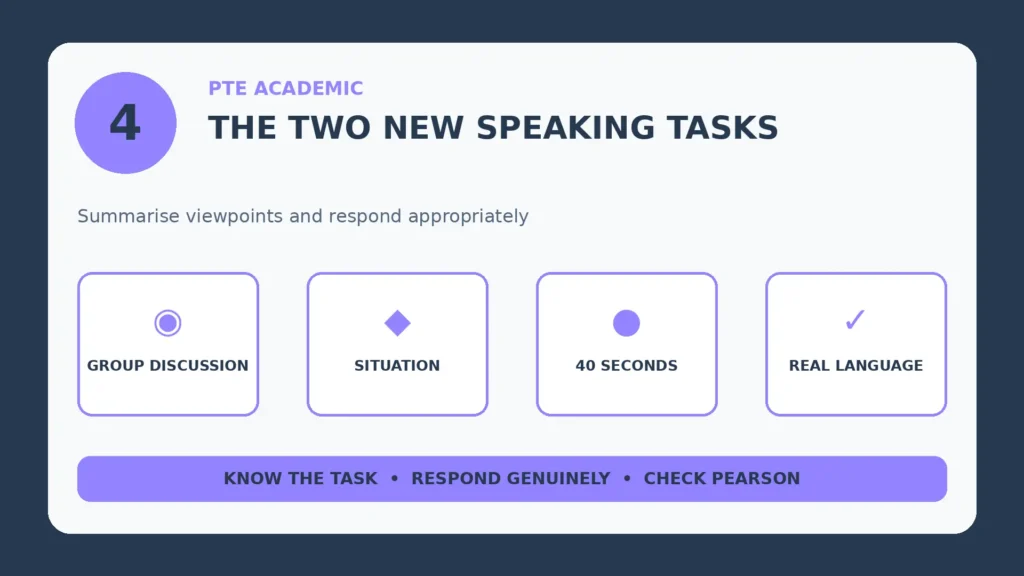
Summarise viewpoints and respond appropriately
Summarize Group Discussion and Respond to a Situation became part of PTE Academic and PTE Academic UKVI after 7 August 2025. They expand the Speaking and Writing part from the older format and are designed to sample communication that resembles real academic and campus life. Candidates using older books must add these tasks to their preparation.
In Summarize Group Discussion, candidates listen to several people discussing a subject, prepare briefly and give a spoken summary. The objective is not to reproduce every sentence. Capture the topic, each speaker’s central contribution, important agreements or contrasts and the direction of the discussion. Pearson gives 40 seconds for the spoken answer.
Read More: Speaking Tasks and Microphone Technique
Use a compact note layout with one line per speaker. Record position, reason and example, then mark connections with symbols such as plus, contrast or cause. Begin the response with the shared topic, organise viewpoints logically and close with the discussion’s broad outcome. Avoid inserting your own opinion unless the task asks for it.
Respond to a Situation presents a real-world context and requires an appropriate spoken response. Identify your role, the listener, the goal and the tone. A request to a tutor, explanation to a classmate and complaint to an administrator should not sound identical. State the purpose early, include essential detail and finish with a workable action or question.
Both tasks reward relevance and genuine communication. A memorised paragraph can fail because it does not reflect the speakers, relationship or purpose. Build flexible language for agreeing, contrasting, requesting, apologising, clarifying and proposing solutions, then adapt it to the item.
Practise in three stages: untimed content selection, timed delivery and detailed review. For group summaries, compare notes with the recording and check whether every main viewpoint was represented fairly. For situations, check tone, completeness and natural phrasing. Finally, repeat with the official time so that clear organisation becomes automatic.
A practical preparation method
Start with the current official format and a diagnostic test. Record the score, but also label each weakness: content selection, vocabulary, grammar, pronunciation, oral fluency, spelling, lost attention, time management or interface error. Because integrated tasks can contribute evidence to more than one communicative skill, diagnose the underlying language behaviour rather than assuming every low score belongs to the section heading.
Use five focused sessions each week. Rotate Speaking and Writing, Reading, Listening and a mixed computer session. Include ten minutes of vocabulary, collocations or sentence construction on most days. Work with a headset and keyboard from the beginning. Save recordings and written responses with dates so that changes in clarity, completion, pace and accuracy are visible.
Review is where improvement becomes specific. For selected-response items, prove why the answer is correct and why distractors fail. For productive tasks, compare the response with Pearson’s instructions and scoring information. Identify one change, repeat a similar item and check whether the correction survives under time pressure. Avoid relying on rigid templates that can produce irrelevant, copied or unnatural language.
Complete a realistic full simulation regularly. Reproduce the current section order, automatic audio, one-hearing rule, microphone behaviour and limited breaks. Afterward, separate language problems from test-interface problems. In the final week, revisit proven routines, confirm booking and identification details and protect sleep. Official Pearson instructions override social-media shortcuts whenever advice conflicts.
Track progress through evidence: task completion, error frequency, timed accuracy, intelligibility and dated samples. A difficult session is useful when it reveals a repeatable pattern and creates a clear next action. Simply completing more questions without analysis may rehearse the same mistake.

Keep the process calm, measurable and centred on real communication.
Quick FAQ
Do I need a particular accent?
No. Aim for clear, intelligible speech, natural rhythm and accurate content.
Should I memorise universal templates?
Flexible structures can help planning, but copied or irrelevant language can damage performance. Respond genuinely to the item.
Is the overall score an average of four skills?
No. Pearson states that the overall 10–90 score is based on performance across the test and is not a simple average of the four communicative-skill scores.