
The IELTS Speaking test is designed to assess how well you can communicate in spoken English. It is the same for IELTS Academic and IELTS General Training. The test usually lasts 11 to 14 minutes and is conducted with a trained IELTS examiner. It may be face-to-face or by video call, depending on the test centre.
Many candidates feel nervous about the Speaking section because it takes place in real time. Unlike Reading or Writing, you cannot go back and change your answer. However, the test becomes much easier when you understand the format, know what examiners are looking for, and practise answering naturally.
Read More: IELTS Reading Strategies for Higher Scores
What Happens in the IELTS Speaking Test?
The Speaking test has three parts:
| Part | Time | What Happens |
| —— | ———– | ——————————————– |
| Part 1 | 4–5 minutes | Short questions about familiar topics |
| Part 2 | 3–4 minutes | A one-to-two-minute talk using a cue card |
| Part 3 | 4–5 minutes | Deeper discussion linked to the Part 2 topic |
The test is recorded for assessment and quality control. The examiner will guide you through each part, so you do not need to memorise instructions.
Part 1: Introduction and Familiar Questions
In Part 1, the examiner asks general questions about you and everyday topics. These may include your home, work, studies, hobbies, family, food, transport, weather, technology, or daily routine.
Example questions:
– Do you work or are you a student?
– What do you like about your hometown?
– How often do you use public transport?
– Do you enjoy cooking?
– What kind of music do you like?
Your answers should not be too short. If the examiner asks, “Do you like reading?” do not only say, “Yes.” Extend your answer naturally:
Yes, I do. I especially enjoy reading short articles online because they help me learn new ideas quickly. I do not read many novels, but I like biographies and history books.
This answer is still simple, but it gives reasons and examples.
Part 2: The Long Turn
In Part 2, you receive a cue card with a topic and bullet points. You get one minute to prepare and then speak for one to two minutes.
Example cue card:
Describe a place you visited that you enjoyed.
You should say:
– where it was
– when you went there
– what you did there
– and explain why you enjoyed it
Use your preparation minute wisely. Write quick notes, not full sentences. Think of a simple structure: introduction, details, story, and feeling.
A strong Part 2 answer often includes:
– A clear opening sentence
– Specific details
– A short story or memory
– Reasons and feelings
– A concluding comment
You do not need to speak perfectly. The goal is to keep talking clearly and naturally until the examiner stops you.
Part 3: Discussion and Deeper Ideas
Part 3 is more abstract and analytical. The questions are usually connected to the Part 2 topic but are broader and less personal.
If Part 2 was about a place you visited, Part 3 might include:
– Why do people like travelling?
– How has tourism changed in recent years?
– What are the advantages and disadvantages of international tourism?
– Should governments protect historical places?
In Part 3, examiners expect longer, more developed answers. You should explain your opinion, give reasons, compare ideas, and sometimes discuss both sides.
Example answer:
I think tourism can be very beneficial because it creates jobs and helps people learn about different cultures. However, it can also damage local communities if too many visitors arrive at once. For example, some historic cities become overcrowded, and local residents may find daily life more expensive. So, I believe tourism needs to be managed carefully.
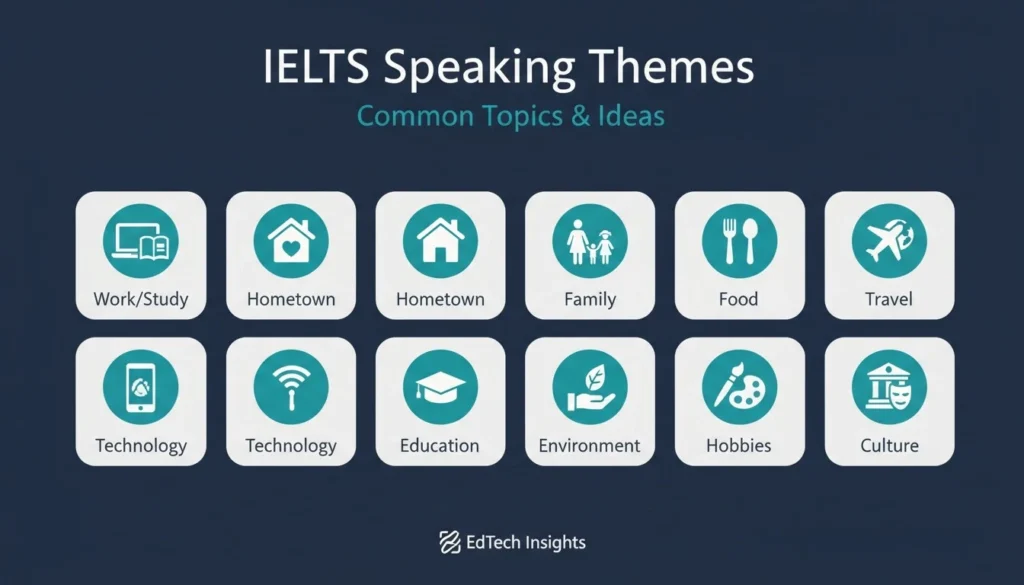
Common IELTS Speaking Themes
IELTS Speaking questions often come from familiar areas of life. Common themes include:
– Work and study
– Home and hometown
– Family and friends
– Food and health
– Travel and transport
– Technology and media
– Education
– Environment
– Shopping and money
– Culture and traditions
– Free time and hobbies
You should not memorise full answers. Instead, prepare useful vocabulary, personal examples, and flexible ideas for each theme.
How to Extend Answers Naturally
A simple way to extend answers is to use this formula:
Answer + Reason + Example + Extra detail
Question:
Do you enjoy watching films?
Answer:
Yes, I do.
Reason:
They help me relax after a busy day.
Example:
For example, I often watch comedies or light dramas at the weekend.
Extra detail:
I prefer films with strong characters rather than too many special effects.
Full answer:
Yes, I do. They help me relax after a busy day. For example, I often watch comedies or light dramas at the weekend. I prefer films with strong characters rather than too many special effects.
This sounds natural and gives the examiner more language to assess.
Fluency Tips for IELTS Speaking
Fluency does not mean speaking very fast. It means speaking smoothly, with only natural pauses. To improve fluency:
– Practise speaking for one or two minutes on familiar topics
– Record yourself and listen for pauses
– Use linking phrases such as “on the other hand,” “for example,” and “as a result”
– Do not translate every sentence from your first language
– Learn how to paraphrase when you forget a word
If you forget a word, describe it. For example, if you forget “recycling bin,” you can say, “the container where people put paper, plastic, or glass to be used again.”
How Examiners Assess Speaking
IELTS Speaking is assessed using four main criteria:
| Criterion | What It Means |
| ————————– | ——————————————– |
| Fluency and coherence | How smoothly and logically you speak |
| Lexical resource | Your range and accuracy of vocabulary |
| Grammar range and accuracy | Your sentence structures and grammar control |
| Pronunciation | How clearly and naturally you speak |
You do not need a British or American accent. Pronunciation means clarity, word stress, sentence rhythm, and whether the examiner can understand you easily.
Common Mistakes to Avoid
Many candidates lose marks because they:
– Give very short answers
– Memorise answers that sound unnatural
– Speak too fast because of nerves
– Repeat the same words too often
– Avoid giving examples
– Panic when they make a small mistake
– Use complex grammar incorrectly
– Focus on accent instead of clarity
Small grammar mistakes are normal. Do not stop and apologise every time you make an error. Keep speaking and focus on communication.

Final Advice
The IELTS Speaking test is a conversation, not a performance. You do not need perfect English, but you do need clear, developed, and natural answers. Practise common themes, learn to extend your ideas, and become comfortable speaking for longer periods.
The best preparation is regular speaking practice. Record yourself, answer real IELTS-style questions, and focus on improving one skill at a time: fluency, vocabulary, grammar, or pronunciation. With the right practice, the Speaking test becomes much less frightening and much more manageable.